Monday 13 Jul 2026
Work begins to transform Barking Eurohub into Britain’s gateway for European rail freight
- Region & Route:
- National
- | Eastern: Anglia
£15 million investment enters delivery phase as three-year programme gets underway.
Work has officially begun to transform Barking Eurohub into a modern international rail freight hub, marking a major step forward in the Government’s plans to grow rail freight and re-establish direct cross-Channel freight services through the Channel Tunnel.
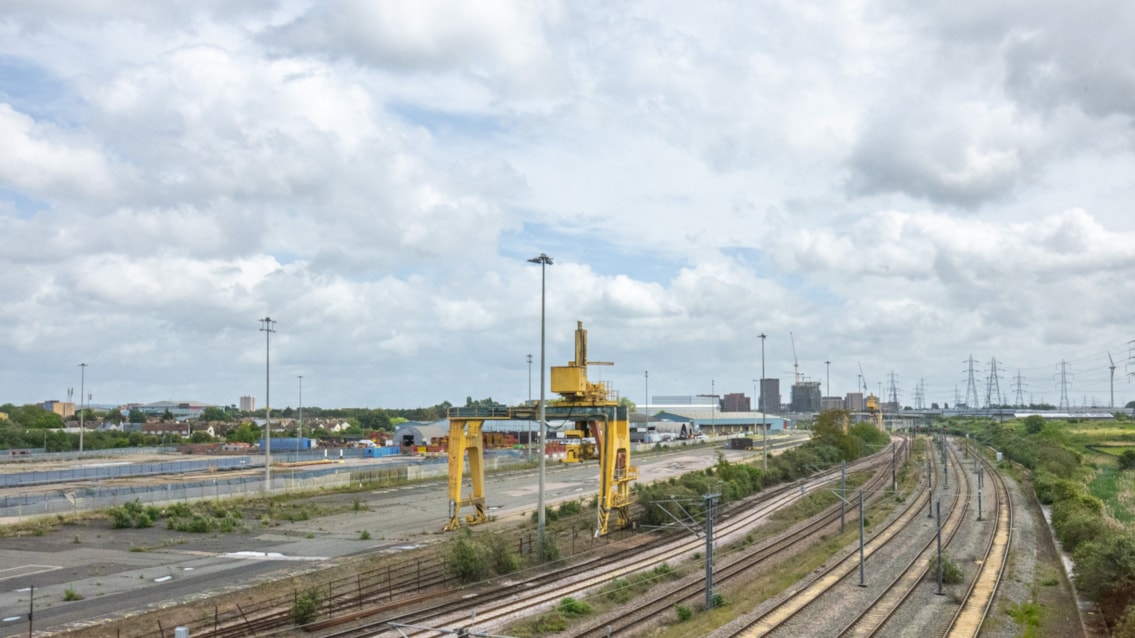
The transformation will see Barking Eurohub – a 40-acre site located in east London – redeveloped into a fully operational international intermodal freight facility. It will feature an intermodal terminal capable of handling containers and liftable lorry trailers arriving and departing by rail and a campus of related distribution and storage activity. Once complete, the site will act as a significant hub for freight travelling to and from major continental European markets including France, Germany, Italy and Spain via the Channel Tunnel.
Work will involve removing old sidings that currently restrict parts of the site, freeing up more than five acres of land and creating new berthing sidings for continental freight trains. This will improve the flow of trains through the terminal and support more efficient freight operations.
The connecting freight tracks and intermodal terminal sidings will be remodelled to handle continental freight trains up to 700 metres long, compared with the current operational limit of around 350 to 400 metres. This will allow longer trains to use the terminal, increasing capacity, improving efficiency and helping move more freight by rail.
Rail Minister Lord Hendy said: “This significant investment in international rail freight will boost British businesses by opening new trade links and deliver faster, more sustainable ways to transport goods between UK and Europe.
“Our ambitious targets for rail freight are strengthening UK supply chains, supporting economic growth and jobs and cementing the UK's position as a hub for international trade.”
Jeremy Westlake, Network Rail’s Chief Executive, said: “This is an important milestone for Network Rail and for the future of British freight. Bringing back regular cross-Channel rail freight services will help take lorries off roads, reduce carbon emissions, and strengthen trade with Europe. This investment shows how railway land and infrastructure can support businesses, communities and the environment as we move towards Great British Railways.”
The works represent the first tangible step in returning regular cross-Channel rail freight services, which have been significantly underutilised in recent years. Shifting containers from road to rail will reduce lorry journeys and congestion on motorways across the South East, cutting carbon emissions and reducing wear on road infrastructure.
Income generated from the Barking Eurohub site will be reinvested into freight growth across Britain, supporting the Government's 2050 rail freight ambitions. The redevelopment is a core objective of the future Great British Railways and demonstrates how railway assets can be used to fund long-term, sustainable improvements to the network.
Maggie Simpson OBE, Rail Freight Group’s Director General, said: “It’s great to see the rapid progress in developing this important site which is essential to the future of international rail freight. We look forward to seeing the development take shape and new services starting in due course.”
The Barking Eurohub site is being redeveloped in partnership with Platform4 and Legal & General, with Network Rail providing infrastructure expertise throughout the three-year programme.
Notes to Editors
About Barking Eurohub: Barking Eurohub is a rail freight terminal site in east London, strategically located for onward distribution across the capital and the South East. The site will handle intermodal freight – containers and liftable lorry trailers – travelling to and from Europe via the Channel Tunnel.
About intermodal freight: Intermodal freight refers to the movement of cargo in containers or liftable lorry trailers that can be transported using two or more modes of transport – such as rail, road, or sea – without the cargo itself being transferred between vehicles. Moving freight by rail is significantly less carbon-intensive than road haulage.
About the Government's 2050 rail freight ambitions: The Government has set out long-term ambitions to grow rail freight as part of its wider industrial strategy and clean energy mission. Growing rail freight reduces road congestion, lowers carbon emissions, and supports stronger trade connectivity across Britain and with Europe.
About Great British Railways: Great British Railways will be the single national body responsible for running and developing Britain's railway. Rail freight growth, including the development of strategic sites such as Barking Eurohub, is a core part of its mandate.
Contact information
Passengers / community members
Network Rail national helpline
03457 11 41 41
Latest travel advice
Please visit National Rail Enquiries
Journalists
Tala Ghannam
Media & PR Manager - National
Network Rail
020 3356 8700
07548 108907
tala.ghannam2@networkrail.co.uk
About Network Rail
We own, operate and develop Britain's railway infrastructure; that's 20,000 miles of track, 30,000 bridges, tunnels and viaducts and the thousands of signals, level crossings and stations. We run 20 of the UK's largest stations while all the others, over 2,500, are run by the country's train operating companies.
Usually, there are almost five million journeys made in the UK and over 600 freight trains run on the network. People depend on Britain's railway for their daily commute, to visit friends and loved ones and to get them home safe every day. Our role is to deliver a safe and reliable railway, so we carefully manage and deliver thousands of projects every year that form part of the multi-billion pound Railway Upgrade Plan, to grow and expand the nation's railway network to respond to the tremendous growth and demand the railway has experienced - a doubling of passenger journeys over the past 20 years.
Follow us on Twitter: @networkrail
Visit our online newsroom: www.networkrailmediacentre.co.uk