Wednesday 27 May 2026
Midland Main Line upgrades unlock new freight capability and resilience
- Region & Route:
- Eastern
- | Eastern: East Midlands
Progress linked to the Midland Main Line Electrification programme is delivering lasting benefits for rail freight – strengthening one of the UK’s most important cross‑country corridors and unlocking greater flexibility for freight operators.
The Midland corridor plays a vital role in the national freight network, providing one of the few, more direct inland links between the West Coast Main Line, East Coast Main Line and strategic inland terminals in the East and West Midlands. The route between Birmingham, Nuneaton, Leicester and Peterborough is the only practical alternative to going through London, but it can’t easily handle today’s larger container trains.
Although the electrification programme was paused by the Government in summer 2025, earlier structure works between Sileby, Loughborough and Trent created a strong foundation by making more space for larger freight containers to pass through key parts of the route.
Building on this, Network Rail identified further structures on the Midland Main Line that could create additional freight capability without the need for new capital investment.
One example is the Kirk Hill bridge replacement at Sutton Bonington, Nottinghamshire. The bridge was due to be reconstructed as part of the electrification of the Midland Main Line. It was agreed that, despite the pause on MML electrification, the bridge reconstruction should continue due to the clearance it would provide for larger freight containers to run through this area.
The old Kirk Hill bridge being demolished (credit: Amco)
The old bridge was demolished over the Christmas period in 2025 when no trains were running, with the new deck lifted into place during overnight weekend possessions in February and March this year, avoiding disruption to passenger services. Larger container services commenced running in both directions under the bridge in April, taking almost immediate advantage of the quicker route between East Midlands Gateway and the East Coast Ports.

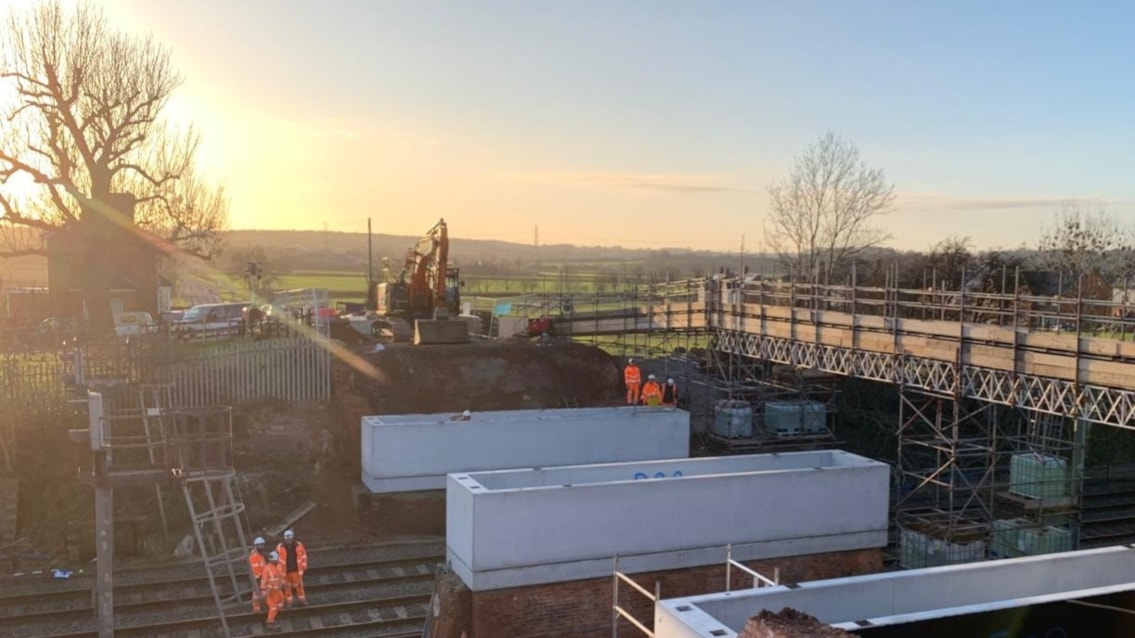
The new Kirk Hill bridge being constructed, March 2026
The new Kirk Hill bridge brings tangible operational and freight benefits. It provides additional clearance for larger‑gauge freight trains and helps to reduce road congestion by enabling more goods to move by rail. It also allows ‘tamping’ maintenance machines to access the area, supporting progress towards removing a long‑standing speed restriction and improving reliability.
In addition, the new, raised structure offers sufficient clearance for electric or bi‑mode trains, should Midland Main Line electrification be restarted in the future.
Through detailed gauging analysis and close collaboration with industry partners, Network Rail has now unlocked additional routes across the East Midlands. Trent High Level, including the Ratcliffe Junction-Toton and Attenborough Junction-Toton sections, and the Trent-Nottingham-Boultham Junction route to Lincoln, are also now available for larger freight containers.
Crucially for both Network Rail and the rail freight industry, this work has been aligned with a wider review of engineering access which has led to improvements in both maintenance access and ensuring a diversionary route is available for container traffic.
Work such as parapets, drainage and reinstatement of utilities will continue at Kirk Hill over the coming months to fully complete the project, but now that the bridge deck has been raised it is already delivering benefits to freight operators.
Katie Oliver, Network Rail lead portfolio manager, said:
“We’re really pleased to keep the momentum going on the Midland Main Line by working with freight partners to rebuild Kirk Hill bridge. It opens up a more direct route for larger containers and gives operators greater flexibility and reliability.
“By taking a fresh look at what the existing railway can handle, we’ve unlocked real benefits for freight, passengers and the wider economy – without the need for big new spending.
“Kirk Hill shows what can be achieved by upgrading older infrastructure: removing long-standing constraints, enabling larger freight trains and keeping the route ready for future electrification, all while keeping disruption to a minimum.”
Contact information
Passengers / community members
Network Rail national helpline
03457 11 41 41
Latest travel advice
Please visit National Rail Enquiries
Journalists
Gareth Dennison
Media relations manager, Eastern region
Network Rail
07561 874858
gareth.dennison@networkrail.co.uk
About Network Rail
We own, operate and develop Britain's railway infrastructure; that's 20,000 miles of track, 30,000 bridges, tunnels and viaducts and the thousands of signals, level crossings and stations. We run 20 of the UK's largest stations while all the others, over 2,500, are run by the country's train operating companies.
Usually, there are almost five million journeys made in the UK and over 600 freight trains run on the network. People depend on Britain's railway for their daily commute, to visit friends and loved ones and to get them home safe every day. Our role is to deliver a safe and reliable railway, so we carefully manage and deliver thousands of projects every year that form part of the multi-billion pound Railway Upgrade Plan, to grow and expand the nation's railway network to respond to the tremendous growth and demand the railway has experienced - a doubling of passenger journeys over the past 20 years.
Follow us on Twitter: @networkrail
Visit our online newsroom: www.networkrailmediacentre.co.uk