Monday 23 Nov 2026
Latest campaign reveals 150 incidents with young people at Anglia level crossings in three years
- Region & Route:
- Eastern: Anglia
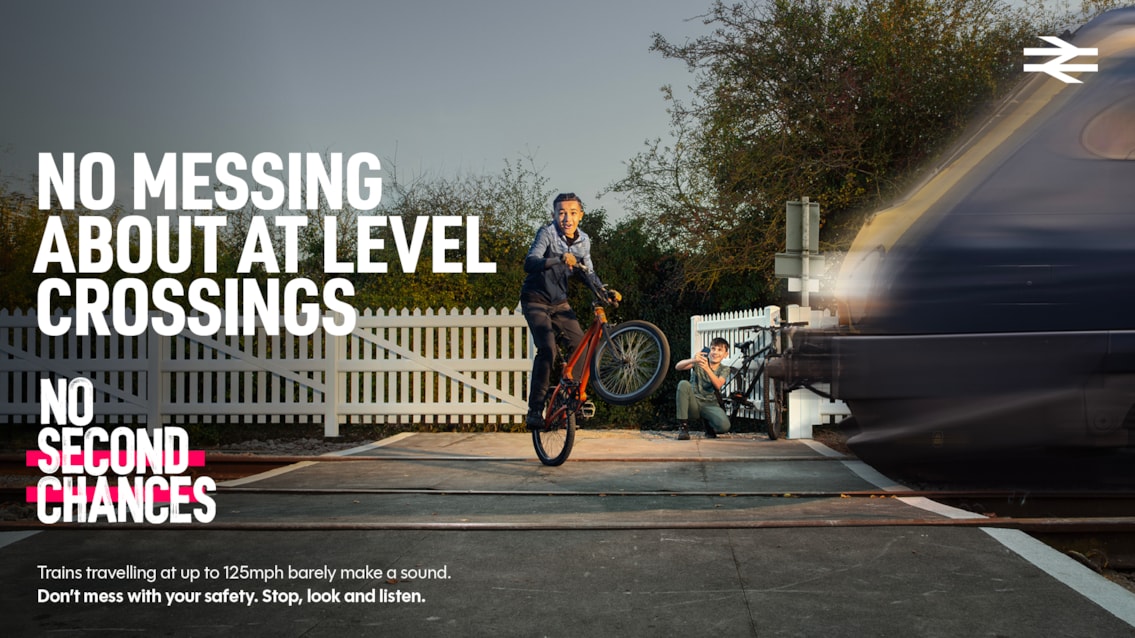
GBR Anglia, comprising Network Rail Anglia, c2c and Greater Anglia, is today supporting the launch of a new rail industry safety campaign aimed at children and young teenagers, warning of the potentially fatal consequences of misusing level crossings and not giving their full attention when crossing the railway.
The campaign comes amid growing concerns about young people's safety around level crossings. Across the Anglia route, there have been over 2000 incidents recorded over the past three years,153 (8%) of which involve under-18s. This forms part of a wider picture as data collected shows a growing trend of children and young people misusing level crossings each year, increasing from 37 incidents in 2017/18 to 61 incidents by 2025/26. And this year is likely to be no exception as a further 42 incidents have already been recorded during 2026/27*.
The latest edition of the ‘No Second Chances’ campaign also comes after Brickfields level crossing in East London was recently closed after a camera survey of how the crossing was being used captured repeated dangerous behaviour by young people. The crossing will remain closed while visits to local schools take place to help young people understand the dangers of misuse or inattention at level crossings.

(Image captured of young teens misusing the level crossing at Brickfields)

Similar concerns have also been raised at Stennetts footpath level crossing in Suffolk, where groups of young people were seen gathering on and around the crossing shortly before the start of the summer holidays. With the support of Suffolk County Council, Network Rail initiated an emergency closure in 2024, and the crossing remains closed.

(CCTV Image captured of young teens loitering in the level crossing at Stennetts)
The rail industry’s 'No Second Chances' safety campaign is therefore now turning its focus onto this age group (10-15 year olds) to raise awareness of level crossing risks, challenge unsafe behaviour, and encourage people to stop, look and listen every time they cross the railway.
The campaign specifically responds to two dangerous forms of behaviour:
- Distraction – such as using phones, wearing headphones or talking to friends while crossing the railway
- Deliberate misuse – including dangerous behaviour such as playing 'chicken', loitering on the crossing to take photos and videos, and intentionally circumventing barriers.
GBR Anglia is also encouraging parents and carers to talk to children about the risks and help them understand how to make safe decisions around the railway. From September 2026, rail safety education has been mandatory in the school curriculum in England, with pupils aged 3-16 being educated on rail safety, including dangerous social media trends and peer pressure encouraging bad behaviour on or near railways.
Shenel Bullock, Head of Level Crossings for Network Rail, working as part of GBR Anglia: "There are no second chances on the railway. And just because a level crossing is familiar, it doesn’t reduce the risk. One mistake or moment of distraction can have devastating consequences.
"For most young people, using a phone, chatting with friends or messing around is part of everyday life. But at a level crossing, one distraction or wrong decision could be fatal.
"That's why we’re reaching out directly to young people with this campaign. Our message is simple: level crossings must always be taken seriously, every time and always expect to see a train. Before you cross, put phones away and remove headphones so that you can fully focus. Read the signs. Stop, look and listen, follow the warnings, and never take a risk around the railway."
Alongside its public-facing safety campaigns, nationally Network Rail has undertaken a wide range of work to improve public safety at level crossings. This includes investing in bridges to completely remove the risk to the public, installing miniature stoplight warning systems to automatically inform users when trains are approaching, rolling out new safety signs to enhance understanding about safe use of level crossings, and updating user guides in efforts to support continuous education and community engagement to reduce risk at level crossings. In Anglia, a long-running programme to close and upgrade level crossings across the route is helping to further improve safety and reduce opportunities for misuse.
(Miniature stoplight warning system at one of the level crossings in Anglia)

There are nearly 6,000 level crossings across England, Wales and Scotland, with Network Rail having closed more than 1,400 crossings since 2009. For public safety, Network Rail will always look to close level crossings where possible and appropriate. This may be through a straight closure, diversion, or through the introduction of new infrastructure.
BTP Chief Inspector Joe Gorman said: “Level crossings are safe when used correctly, but they can become incredibly dangerous in an instant if people ignore warnings, take risks or become distracted. We continue to see incidents involving young people at crossings, whether distracted by mobile phone use, peer pressure or deliberate misuse, but what may seem like harmless behaviour can have devastating consequences.
“That’s why campaigns like this are so important, so that young people are educated about the dangers of the railway, and they can make safer decisions. We urge young people to respect the railways and keep safe. If you witness unsafe behaviour on or near the railway, report it to British Transport Police by texting 61016.”
Notes to Editors
*The 42 incidents recorded for 2026/27 cover only a part of the financial year. Further reporting remains as we proceed, so this figure is provisional and does not represent the final annual total of 2026/27.
https://www.networkrail.co.uk/who-we-are/safety-in-the-community/level-crossing-safety/
https://www.networkrail.co.uk/who-we-are/safety-in-the-community/level-crossing-safety/using-level-crossings-safely/
Level crossing incidents rise on Anglia as survey reveals young adults underestimate speed of trains
Contact information
Passengers / community members
Network Rail national helpline
03457 11 41 41
Latest travel advice
Please visit National Rail Enquiries
Journalists
Dakshin Kumudhini
Communications Manager
Network Rail
dakshin.kumudhini@networkrail.co.uk
About Network Rail
We own, operate and develop Britain's railway infrastructure; that's 20,000 miles of track, 30,000 bridges, tunnels and viaducts and the thousands of signals, level crossings and stations. We run 20 of the UK's largest stations while all the others, over 2,500, are run by the country's train operating companies.
Usually, there are almost five million journeys made in the UK and over 600 freight trains run on the network. People depend on Britain's railway for their daily commute, to visit friends and loved ones and to get them home safe every day. Our role is to deliver a safe and reliable railway, so we carefully manage and deliver thousands of projects every year that form part of the multi-billion pound Railway Upgrade Plan, to grow and expand the nation's railway network to respond to the tremendous growth and demand the railway has experienced - a doubling of passenger journeys over the past 20 years.
Follow us on Twitter: @networkrail
Visit our online newsroom: www.networkrailmediacentre.co.uk