Friday 24 Apr 2026
Level crossing incidents rise on Anglia as survey reveals young adults underestimate speed of trains
- Region & Route:
- Eastern: Anglia
New research released today reveals dangerous overconfidence is putting young adults’ lives at risk, with incidents involving the incorrect use of Anglia's level crossings increasing by more than 20% in a year.
- Seven out of ten 18-34 year olds believe they could get out of the way if a train approached
- 98% of these young adults are unaware how long trains take to stop in an emergency
- The number of incidents involving the incorrect use of level crossings by pedestrians and cyclists on Anglia has increased by more than 20%, from 253 incidents in 2024 to 304 in 2025
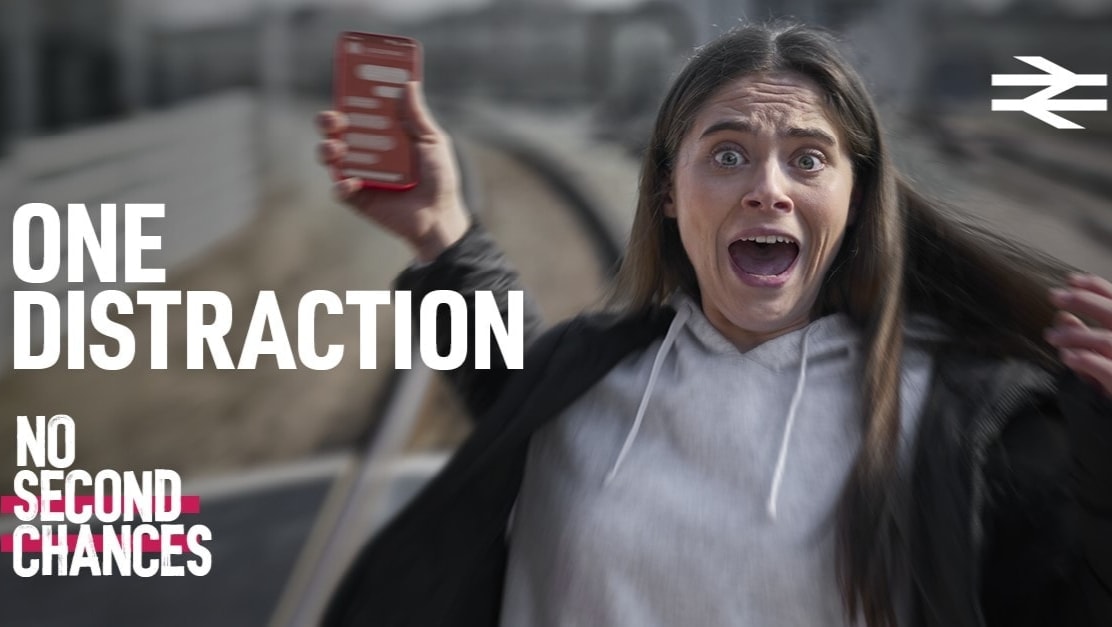
- Survey marks start of No Second Chances campaign – featuring a series of hard-hitting films – which focuses on the deadly risks of distraction when approaching the railway
Even though eight in ten 18-34 year olds claim to understand the risks, the same number also fail to recognise key warning signs of an approaching train.
Furthermore, seven in ten young adults feel confident they could move out of the way in time if a train appeared while crossing, despite trains travelling up to five times faster than cars. Worryingly, almost all young adults surveyed – a staggering 98% – didn’t know it takes around a mile for a train travelling at 80mph to make an emergency stop.
The findings come as Network Rail, British Transport Police, c2c, Greater Anglia and train operators across the country join forces to launch the first ever industry-wide safety campaign to raise awareness of the dangers around level crossings – called No Second Chances. The campaign is rolling out as the rail industry moves towards a unified Great British Railways.
Aimed primarily at young adults, the campaign focuses on the deadly consequences of distraction at level crossings through a series of uncompromising 20 second films. It is aimed primarily at young adults who, in the survey* commissioned by Network Rail, were much more likely to admit to distracted behaviour while crossing.
The research suggests a gap between intention and reality in the way people use level crossings. In the east of England, 82% say they would remove headphones before crossing and 88% say they would stop using their phone, yet many still admit to behaviours such as chatting, rushing or filming near crossings, which can reduce awareness and increase risk.
There are more than 650 level crossings in operation across Anglia, with various safety features based on their location and levels of use. These safety features include lowering full or half barriers to block access to the track, as well as audible sirens and flashing lights warning of an approaching train.
Shenel Bullock, Network Rail Anglia route health and safety manager, said: “We know how easy it is to get distracted, whether that’s listening to a favourite podcast, looking at your phone or just taking for granted familiar surroundings. But stepping onto a level crossing without stopping to look and listen can be fatal. When it’s you versus a train, there are no second chances."
Rob Mullen, c2c managing director, said: “Level crossings across the c2c route and the wider rail network present a significant and ongoing risk to life when signals and warnings are ignored, or they are not used properly.
"There continue to be far too many reported incidents of level crossing misuse in the Anglia region, and we must work together through campaigns such as No Second Chances to improve awareness, while educating our customers, colleagues and the communities we serve."
Matthew Wakefield, Greater Anglia safety, security and sustainability director, said: “While most people believe they understand the risks at level crossings, this research shows a dangerous gap between perception and reality, particularly among younger people who may overestimate how much time they have.
“At higher speeds, it can take up to a mile for a train to come to a standstill, which means once a driver sees someone on the crossing, there is often very little they can do. With misuse continuing to rise, it is vital that everyone treats every crossing with care."
The rail industry is urging the public to stay safe when using level crossings by following the advice:
- Stop, look, and listen. Every crossing is different so always read the signs and follow the instructions.
- Understand warning signs (lights, barriers, alarms) and obey them fully. Always follow instructions at each level crossing completely.
- Check both ways before crossing. If there is a train coming, wait behind the barrier or marked line until it has passed. Remember there may be more than one train, and they may be coming from different directions.
- Cross quickly and safely. Make sure your exit route is clear and do not stop when crossing.
Notes to Editors
The No Second Chances campaign formally launched at a cross-industry stakeholder event in London Liverpool Street station on Tuesday 21 April 2026, and will run through to Wednesday 3 June 2026, across various channels including social media, digital platforms and outdoor advertising.
*The survey was conducted by Censuswide via an online panel of 2,001 UK adults, nationally representative by age, gender and region. Fieldwork was conducted between 8th and 10th April 2026.
Contact information
Passengers / community members
Network Rail national helpline
03457 11 41 41
Latest travel advice
Please visit National Rail Enquiries
Journalists
Richard Cooper
Communications manager
Network Rail
0330 8577 132
richard.cooper3@networkrail.co.uk
About Network Rail
We own, operate and develop Britain's railway infrastructure; that's 20,000 miles of track, 30,000 bridges, tunnels and viaducts and the thousands of signals, level crossings and stations. We run 20 of the UK's largest stations while all the others, over 2,500, are run by the country's train operating companies.
Usually, there are almost five million journeys made in the UK and over 600 freight trains run on the network. People depend on Britain's railway for their daily commute, to visit friends and loved ones and to get them home safe every day. Our role is to deliver a safe and reliable railway, so we carefully manage and deliver thousands of projects every year that form part of the multi-billion pound Railway Upgrade Plan, to grow and expand the nation's railway network to respond to the tremendous growth and demand the railway has experienced - a doubling of passenger journeys over the past 20 years.
Follow us on Twitter: @networkrail
Visit our online newsroom: www.networkrailmediacentre.co.uk