Tuesday 24 Mar 2026
World first as development of quantum navigation technology advances onto Britain’s national railway
- Region & Route:
- National
Britain’s railway has taken a major step in the development of quantum navigation technologies, with new systems designed to measure train position with extreme precision now being advanced for the national rail network.
Quantum inertial navigation uses ultra-sensitive sensors capable of detecting minute changes in motion and rotation. Unlike satellite-based navigation systems such as GPS, it does not rely on external signals, meaning it could provide highly resilient positioning even in environments where satellite signals are unavailable, including tunnels, dense infrastructure or areas affected by interference.
The technology is being developed as a potential future alternative to fixed trackside positioning infrastructure, which can be costly to install and maintain and are vulnerable to environmental disruption or equipment failures. Once developed, quantum will enable a lower cost, more reliable, more resilient system.
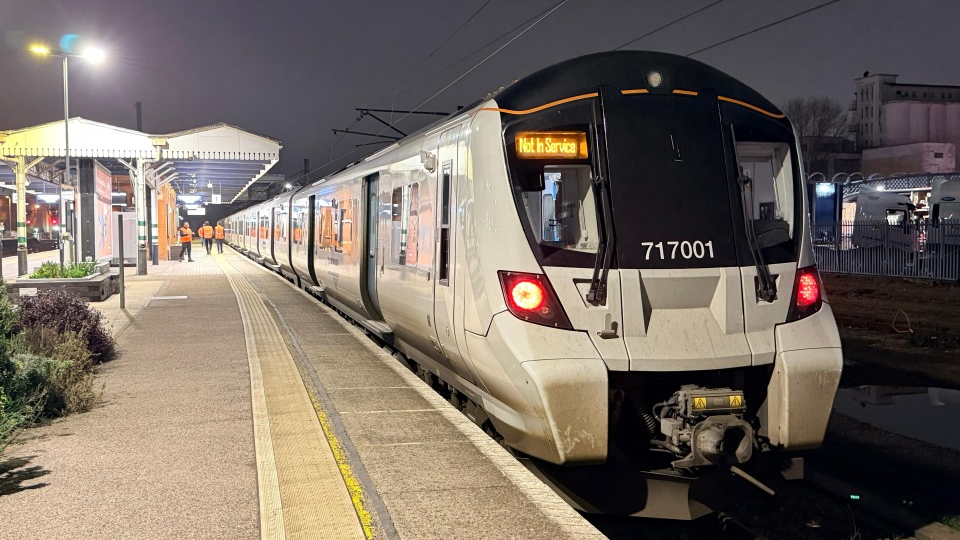
As part of this development programme, a Rail Quantum Inertial Navigation System (RQINS) has now been tested on a mainline railway for the first time anywhere in the world. The system was carried on a Great Northern train operated by Govia Thameslink Railway (GTR) between central London and Welwyn Garden City on Tuesday 3 March, providing real-world data to help understand how quantum positioning technologies perform within the operational environment of a national railway network to inform its development.
This milestone builds on work undertaken by the Ministry of Defence and on Transport for London’s network and represents the next step in developing quantum sensing technologies for use on heavy rail.
The development programme is being progressed through a specialist consortium led by MoniRail, working with Imperial College London, the University of Sussex, QinetiQ, PA Consulting and the National Physical Laboratory, with support from Innovate UK and the Department for Science, Innovation and Technology (DSIT).
This development is convened by GBRX, the strategic innovation and technology body for Great British Railways, to accelerate the adoption of strategic technologies that improve the railway for passengers and freight.
Rail Minister Lord Peter Hendy, said: “For more than two centuries Britain’s railway has forged technologies that have shaped the modern world. The development of quantum inertial navigation continues that legacy. With these new capabilities, we're preventing equipment failures, helping to boost our railway's reliability and keeping passengers moving.
"It's all part of our plan to modernise track and train under Great British Railways, adopting world-leading technology that increases resilience to improve passenger experience while supporting jobs, growth and homes.”
Toufic Machnouk, managing director of GBRX, said: “Developing new technologies within the complexity of a railway network is essential to understanding how frontier technologies can be translated into operational capability.
“Quantum sensing is one of the UK Government’s frontier technological priorities. Railways, as one of the country’s most complex operational systems, provide a powerful platform for developing and scaling these capabilities for rail and beyond.
“This programme begins the process of understanding how quantum positioning could fundamentally reshape how railways work. In the future, it could reduce reliance on costly trackside positioning systems while enabling new capabilities for signalling, improved operational performance, network planning, enhanced condition monitoring and more intelligent railway operations.
“This test represents an early but important step in that development journey and demonstrates how collaboration between government, academia and industry can accelerate the development of frontier technologies.”
Notes to Editors
GBRX is the strategic innovation and technology body for Great British Railways. Its purpose is to convene the rail sector to overcome barriers to the adoption of strategic technologies that improve how the railway works for people and create sustainable skills for the future.
Contact information
Passengers / community members
Network Rail national helpline
03457 11 41 41
Latest travel advice
Please visit National Rail Enquiries
Journalists
Tala Ghannam
Media & PR Manager - National
Network Rail
020 3356 8700
07548 108907
tala.ghannam2@networkrail.co.uk
About Network Rail
We own, operate and develop Britain's railway infrastructure; that's 20,000 miles of track, 30,000 bridges, tunnels and viaducts and the thousands of signals, level crossings and stations. We run 20 of the UK's largest stations while all the others, over 2,500, are run by the country's train operating companies.
Usually, there are almost five million journeys made in the UK and over 600 freight trains run on the network. People depend on Britain's railway for their daily commute, to visit friends and loved ones and to get them home safe every day. Our role is to deliver a safe and reliable railway, so we carefully manage and deliver thousands of projects every year that form part of the multi-billion pound Railway Upgrade Plan, to grow and expand the nation's railway network to respond to the tremendous growth and demand the railway has experienced - a doubling of passenger journeys over the past 20 years.
Follow us on Twitter: @networkrail
Visit our online newsroom: www.networkrailmediacentre.co.uk