Thursday 12 Nov 2026
Two million miles and counting: railway's 'Flying Banana' helps keep passengers moving through autumn and winter
- Region & Route:
- National
- The New Measurement Train (NMT) or ‘Flying Banana’ has now covered more than two million miles since it was launched onto the rail network in 2003.
- The train scans the tracks at speeds of up to 125mph, identifying any developing faults before they can become safety or performance issues.
- The NMT is an integral part of the effort to prepare Britain's railway for severe weather - as preparations continue for predicted challenging autumn and winter conditions, fuelled by the El Niño effect.
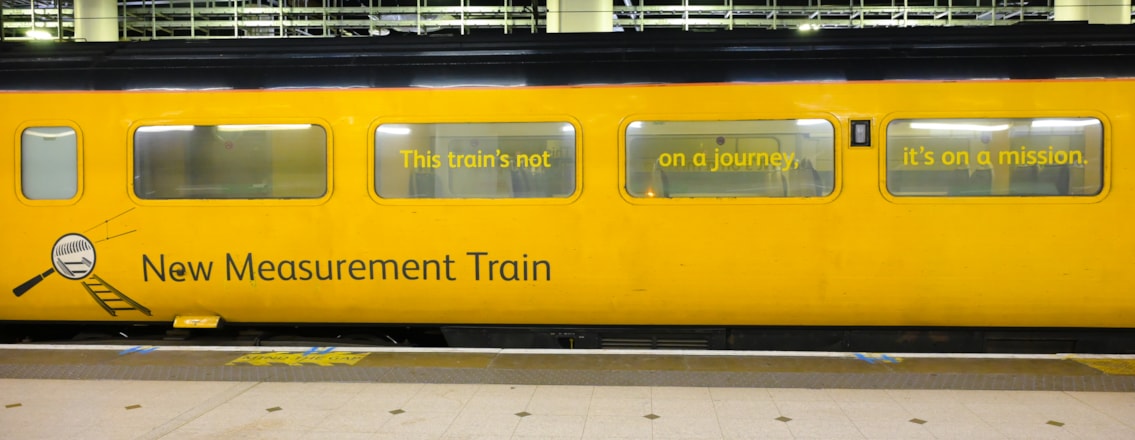
The distinctive yellow New Measurement Train (NMT), affectionately known as the 'Flying Banana', has passed the two million mile mark on its travels across Britain's railway – spotting track troubles early, before they can grow into bigger problems.
Equipped with lasers, cameras and other specialist technology like real-time image analysis, the NMT provides a high-speed health check of the railway, helping engineers identify faults so they can target maintenance work where it is needed most.
But it is at this time of year that the Flying Banana really comes into its own, as a key part in making sure the rail network is as ready as it can be for the challenging weather that comes in autumn and winter.
And this year, forecasters are predicting a greater number of storms than normal will hit Britain, due to El Niño's impact on global weather patterns – making the NMT's job even more crucial.
Stormy weather poses a range of challenges to the railway:
- Heavy rain can overwhelm drainage and contribute to flooding and earthwork instability
- Strong winds can bring trees, branches and other debris onto the railway
- Autumn leaf fall can also reduce the grip between train wheels and rails, affecting trains' ability to brake and accelerate. There are approximately 13 million trees located on, or next to, railway land.
Ahead of, and in the midst of, these added pressures, having an accurate, up-to-date picture of the health of the railway is critical.
Lisa Angus, Network Rail's Industry Weather Response Director, said:
“The NMT is a brilliant example of how technology helps us understand what is happening on the railway, spotting developing problems early so our teams can take action before they affect passengers.
“But it is just one part of a much bigger effort taking place across the railway this autumn and winter. From leaf-busting trains and drainage work to weather monitoring and better forecasting, we are using data, technology and the expertise of our people to understand where the risks are greatest and act earlier.
“We can't prevent severe weather and there will be times when we need to slow or change services to keep people safe. But by preparing carefully and targeting our response where it is needed most, we can help keep as many passenger trains and freight services moving safely and reliably as possible.”
Across the railway, teams have also been out on the ground managing vegetation and closely monitoring locations vulnerable to flooding or landslips, while control rooms have introduced seasonal timetables where necessary to keep trains moving and customers in the know.
This autumn, the railway’s fleet of 67 leaf-busting trains – also known as railhead treatment trains - will travel more than one million miles across the network, which is the equivalent to circling the Earth more than 40 times. They use powerful water jets to remove the slippery layer formed when wet leaves are crushed onto the rails and then applying a special treatment to help train wheels maintain their grip the on track.
The rail industry is investing £2.6 billion between 2024 and 2029 to improve weather and climate resilience, helping the railway better withstand increasingly extreme weather and recover more quickly when disruption does occur.
Passengers are encouraged to check their journey before travelling when severe weather is forecast and follow the latest advice from their train operator and National Rail Enquiries.
ENDS
Contact information
Passengers / community members
Network Rail national helpline
03457 11 41 41
Latest travel advice
Please visit National Rail Enquiries
Journalists
Network Rail press office - Donna Mitchell
Senior Media & PR Manager
Network Rail
020 3356 8700
07850407419
donna.mitchell@networkrail.co.uk
About Network Rail
We own, operate and develop Britain's railway infrastructure; that's 20,000 miles of track, 30,000 bridges, tunnels and viaducts and the thousands of signals, level crossings and stations. We run 20 of the UK's largest stations while all the others, over 2,500, are run by the country's train operating companies.
Usually, there are almost five million journeys made in the UK and over 600 freight trains run on the network. People depend on Britain's railway for their daily commute, to visit friends and loved ones and to get them home safe every day. Our role is to deliver a safe and reliable railway, so we carefully manage and deliver thousands of projects every year that form part of the multi-billion pound Railway Upgrade Plan, to grow and expand the nation's railway network to respond to the tremendous growth and demand the railway has experienced - a doubling of passenger journeys over the past 20 years.
Follow us on Twitter: @networkrail
Visit our online newsroom: www.networkrailmediacentre.co.uk