Tuesday 4 Aug 2026
TRU launches communication cards as part of its commitment to delivering a more accessible railway
- Region & Route:
- Eastern
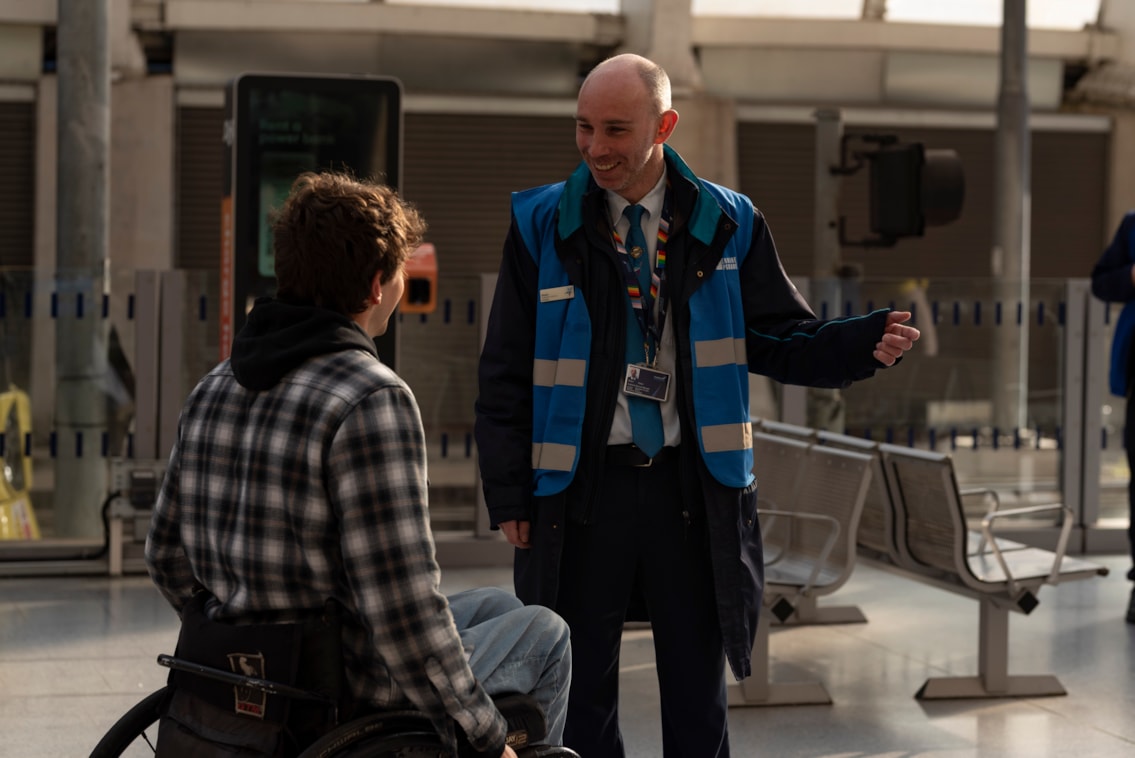
The Transpennine Route Upgrade (TRU) has placed accessibility at the heart of its transformation of the railway across the North since its inception. The latest example of this commitment is the introduction of new Customer Communication Cards, designed to help break down communication barriers between customers and railway staff.
The cards include simple prompts and conversation starters to help customers explain what support they need by showing them to any member of staff, and are available at key stations along the TRU route or as downloadable PDFs from www.thetrupgrade.co.uk/accessibility.
Carl Harland, TRU Accessibility Lead, said:
"For many of our disabled customers, asking for help can be one of the biggest barriers to travel. These cards help start that conversation, giving customers an easy way to communicate their needs and enabling staff to provide support needed for a smooth end-to-end journey.
"For those that need them, the cards are a very positive initiative, with the designs clear and easily readable."
TRU will deliver a railway that is easier to use, more inclusive, and designed so every customer can travel with confidence. The programme is investing in modernised stations along the route that will include:
- Step-free access, making it easier for customers with additional access needs, pushchairs or luggage to move around
- Improved facilities such as accessible waiting shelters, seating and upgraded blue badge parking
- Upgraded signage and wayfinding designed to support customers with visual, cognitive or mobility impairments
- Clearer audio and visual announcements and upgraded Customer Information Screens (CIS)
- Hearing loops installed or improved at key locations to support customers who use hearing aids
To further support customers during improvement works, TRU has introduced other additional tools and processes to make journeys easier, such as Passenger Assist. Passenger Assist allows customers to request help with boarding, alighting, connections and navigating stations, with train operators able to arrange alternative accessible transport if required.
Accessibility remains a priority when rail replacement buses are in operation. All services provide space for one wheelchair user, with an accessible alternative arranged if a vehicle cannot accommodate this. As of 1 August, larger vehicles making shorter journeys between stops will now also provide audible and visual onboard information, supporting customers with visual or hearing impairments.
Dedicated colleagues are deployed at major rail-to-road interchanges to help customers board the correct service and access any assistance they need, while train operator contact centres are on hand to help plan accessible journeys and pre-arrange Passenger Assist.
Notes to Editors
The Transpennine Route Upgrade (TRU) is a multi-billion-pound railway programme that will transform journeys across the North, better connecting towns and cities like Manchester, Huddersfield, Leeds and York.
TRU fast facts
- 25% of the route is now electrified, with electric train services now running between Manchester and Stalybridge, and York and Church Fenton
- Once complete, TRU aims to halve the time lost to delays
- There are currently 70 worksites across the 70-mile route
- TRU will deliver:
- The full electrification of the line
- Double the amount of tracks in key locations, allowing fast trains to overtake stopping services
- Implement digital signalling to increase speed and capacity
- Improve all 23 stations on the route, supporting accessibility
- TRU has over 5000 staff, with 85% coming from within 40 miles of the route – TRU will have created over 8000 jobs across the duration of the programme
- TRU is expanding freight provision, opening 15 extra freight paths and widening tunnels so shipping containers can travel between ports on the east and west coasts via rail, removing over 1000 lorries a day from the busy roads across the Pennines
Key milestones to date
- New station built at Mirfield
- New station built at Morley
- Introduction of a fully accessible platform 2 at Castleford station to support diverted services between York and Manchester
- £100m upgrade of diversionary routes completed ahead of major works across the Transpennine Route, increasing railway resilience
- Upgrade of Hope Valley line complete, with a second platform built at Dore & Totley, as well as 1km of additional track at Bamford to reduce bottlenecks
Contact information
Passengers / community members
Network Rail national helpline
03457 11 41 41
Latest travel advice
Please visit National Rail Enquiries
Journalists
Ewan Bayliss
Communications Executive
Network Rail
ewan.bayliss@networkrail.co.uk
About Network Rail
We own, operate and develop Britain's railway infrastructure; that's 20,000 miles of track, 30,000 bridges, tunnels and viaducts and the thousands of signals, level crossings and stations. We run 20 of the UK's largest stations while all the others, over 2,500, are run by the country's train operating companies.
Usually, there are almost five million journeys made in the UK and over 600 freight trains run on the network. People depend on Britain's railway for their daily commute, to visit friends and loved ones and to get them home safe every day. Our role is to deliver a safe and reliable railway, so we carefully manage and deliver thousands of projects every year that form part of the multi-billion pound Railway Upgrade Plan, to grow and expand the nation's railway network to respond to the tremendous growth and demand the railway has experienced - a doubling of passenger journeys over the past 20 years.
Follow us on Twitter: @networkrail
Visit our online newsroom: www.networkrailmediacentre.co.uk