Friday 15 May 2026
Successful testing of Class 700 train with upgraded digital software
- Region & Route:
- Eastern
- | Eastern: East Coast
Successful testing at speed has been completed of upgraded digital software on a Thameslink Class 700 unit, preparing the largest passenger fleet on the East Coast Main Line (ECML) for the introduction of in-cab digital signalling.
The 115-strong Thameslink fleet is the largest passenger fleet in the Government funded £1.4 billion East Coast Digital Programme (ECDP). ECDP will transform the way rail services are provided by replacing traditional, lineside signals with continuous information displayed inside drivers’ cabs, delivering a more reliable, greener and even safer railway.
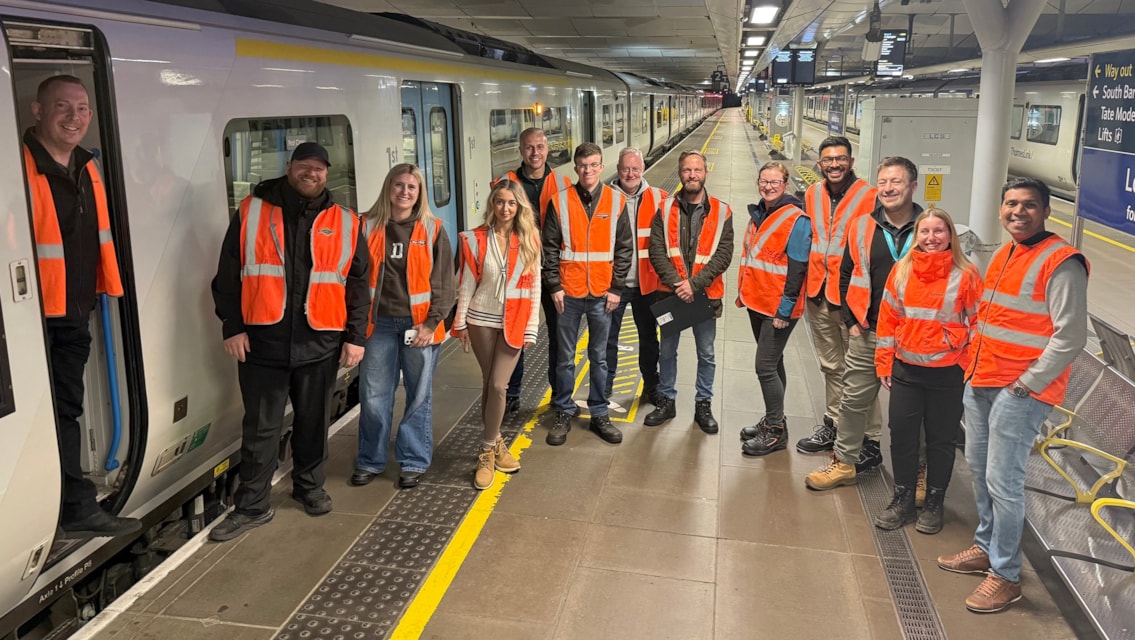
Over two Sunday evenings in April and May, a GTR Class 700 Thameslink train was tested in the Central London ‘core’ section of Thameslink (the section between London Bridge and London St Pancras), using European Train Control System (ETCS) version 3.6.0, an upgrade of the digital signalling software. The testing work was carefully planned to ensure no disruption to the start of Monday morning passenger services at 4.30am.
GTR is currently the only operator in the UK using ETCS 3.6.0 in passenger service, on its Class 717 fleet and this builds on the experience gained using digital signalling on the Northern City Line. The testing, done in collaboration between GTR, Network Rail and Siemens Mobility, was carried out to ensure the train’s existing functions continue to operate normally alongside the benefits of the upgraded software.
The upgraded software allows more flexibility for services to operate in a high traffic area like the ECML by connecting the train to the trackside via GPRS, using ‘packet switching’*.
The first passenger services to use ETCS on the ECML (between Welwyn Garden City and Hitchin) are expected later this year, initially involving Class 717 units. The Class 700 fleet is expected to begin migrating to ETCS on the ECML from 2027. The software upgrade of the Class 700 fleet will also help its readiness for future ETCS on the Brighton Main Line and Midland Main Line.
Aaron Meakin, GTR’s head of ERTMS Onboard, said:
“As the only operator in the UK currently using ETCS version 3.6.0 in customer service, we’re pleased to build on our experience using digital signalling on the Northern City Line. We’re extremely proud of the teams delivering this testing, who worked extremely hard to ensure it was completed on time and safely in a very complex and critical environment, with minimal impact to our customers.”
Ricky Barsby, Network Rail’s ECDP access integration lead, said:
“Getting the largest passenger fleet ready is a vital step in our preparations to gradually migrate to digital signalling on the East Coast Main Line. Having the new baseline level of ETCS in place for all fleets when they migrate will contribute to the resilience and high performance of the next generation railway.”
Richard Cooper, infrastructure lead and ECDP project director, Siemens Mobility UK&I, said:
"Building on the experience gained using digital signalling on the Northern City Line, this upgraded ETCS software on the Siemens-built Class 700 fleet will help deliver a more reliable, connected and sustainable railway for passenger and freight operators on the East Coast Main Line and beyond.”
For further information about ECDP please visit www.eastcoastdigitalprogramme.co.uk.
Notes to Editors
*Packet switching provides high capacity for GSMR (Global System for Mobile Communications-Railway – the railway’s mobile communications system) radios, significantly increasing data capacity on a busy mixed-use railway. It uses the General Packet Radio System (GPRS) which allows mobile networks to transmit IP content.
The benefit of moving from circuit switching to packet switching is increased capacity. With the multiplicity of trains involved in operations on a quadruple-track mainline, circuit switch would provide insufficient bandwidth capacity.
About digital signalling
Digital signalling, using ETCS, is a proven technology already in use in many countries in Europe and elsewhere. The ECDP will see the first introduction of ETCS to an intercity mainline in Great Britain and provide the foundation for the future expansion of digital signalling across the network. ETCS is currently in use in the central London section of Thameslink and on the Cambrian Line in Wales, and on the Northern City Line (Finsbury Park to Moorgate), GB’s first no signals commuter railway, in the first stage of ECDP.
Contact information
Passengers / community members
Network Rail national helpline
03457 11 41 41
Latest travel advice
Please visit National Rail Enquiries
Journalists
Gareth Dennison
Media relations manager, Eastern region
Network Rail
07561 874858
gareth.dennison@networkrail.co.uk
About Network Rail
We own, operate and develop Britain's railway infrastructure; that's 20,000 miles of track, 30,000 bridges, tunnels and viaducts and the thousands of signals, level crossings and stations. We run 20 of the UK's largest stations while all the others, over 2,500, are run by the country's train operating companies.
Usually, there are almost five million journeys made in the UK and over 600 freight trains run on the network. People depend on Britain's railway for their daily commute, to visit friends and loved ones and to get them home safe every day. Our role is to deliver a safe and reliable railway, so we carefully manage and deliver thousands of projects every year that form part of the multi-billion pound Railway Upgrade Plan, to grow and expand the nation's railway network to respond to the tremendous growth and demand the railway has experienced - a doubling of passenger journeys over the past 20 years.
Follow us on Twitter: @networkrail
Visit our online newsroom: www.networkrailmediacentre.co.uk