
Friday 30 Oct 2026
South Western tackles slippery rails and storm damage this autumn
- Region & Route:
- Southern
- | Southern: Wessex
- Leaf-busting trains and enhanced braking technology are helping protect the South Western network during challenging conditions and keep trains running safely and reliably
- Lots of trees fell across the South Western network during last week’s Storm Austen and Storm Boelo, which caused widespread disruption
- The named storms marked the beginning of a challenging time of year for Britain’s railways, with more storms, heavy rain and strong winds expected
- Leaf-busting trains will travel around 140,000 miles to clear tracks on the South Western network
- Major weather resilience projects, from drainage improvements on the Isle of Wight to landslip prevention in Somerset, are helping protect the network against extreme weather
WORK is ongoing across the South Western network to keep customers moving through tough weather conditions this autumn and winter.
Autumn is one of the most challenging seasons on the railway, and more storms, heavy rain and strong winds are expected to follow Storm Austen and Storm Boelo in the months ahead.
Responding to last week’s storms
The storms caused significant disruption across the UK last week, and on the South Western network alone, and lots of trees fell on the railway between Friday 23 and Sunday 25 October.

Damaged conductor rail - An engineer removes the remains of a tree struck by a train (in the distance), which has knocked the conductor rail out of place (third rail from the left).

Damaged coupler on train - Branches wedged below a train in Bournemouth, which has damaged the train's coupler (top left, with electrical warning label).
During the storms, a large tree fell across both lines in the Bournemouth area and became lodged below a passing train, causing damage to the train and the electric third rail.
Dedicated teams removed the tree and stricken train, repaired the damaged track, and re-opened the line for services to resume, hours later.
Britain’s railway network is preparing for more incidents like these and the risks of flooding, high winds and landslips, in addition to the challenges that autumn always brings.
Leaf-busting trains tackle slippery rails
Work to protect the railway from autumn conditions began in the spring, when seasonal delivery specialists, based at South Western’s Rail Operating Centre in Basingstoke, developed a comprehensive plan to keep tracks open and keep trains moving.
Across the industry, train operators have introduced autumn timetables, giving drivers more time to brake and accelerate during the leaf fall season, when wet weather and millions of leaves falling on the line reduces the grip between wheels and rails.

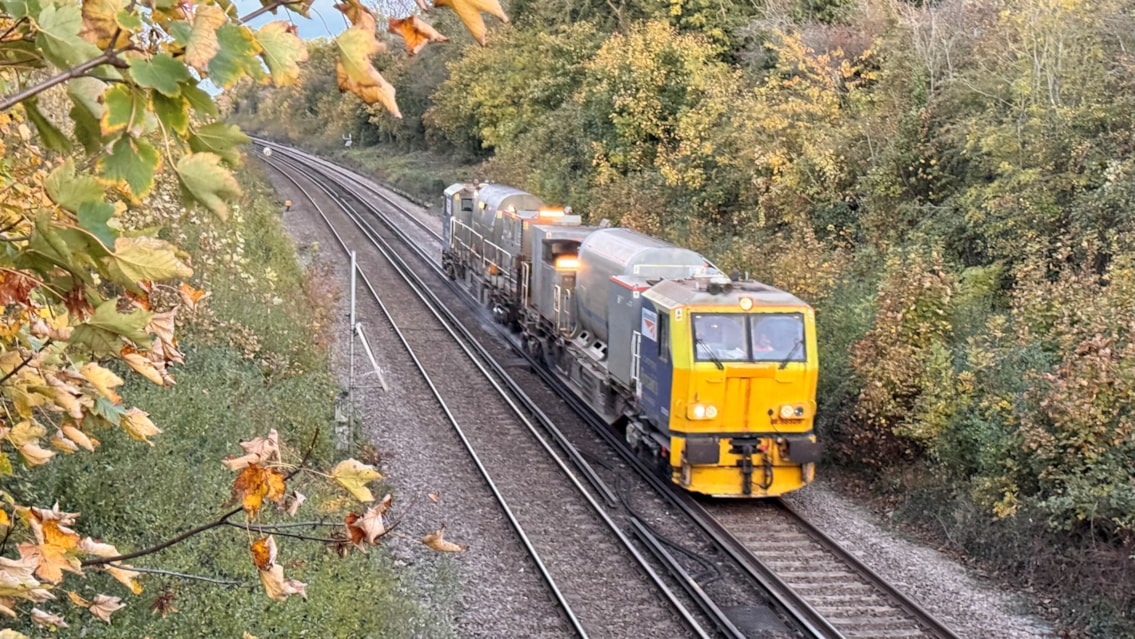
Leaf buster trains at Effingham Junction - Leaf-busting trains based at Effingham Junction in Surrey.
Key to improving that vital grip, or ‘rail adhesion’, is a fleet of ‘leaf-busting’ trains, based at Totton in Hampshire and Effingham in Surrey.
The trains use high-powered water jets to clear the slippery layer that is left on rails by leaves that have been crushed by passing trains. This residue can significantly reduce grip and leave conditions like black ice on roads, making it harder for trains to brake and accelerate.
Last year, the leaf-busters treated nearly 140,000 miles of track on the South Western network, the equivalent of more than five trips around the earth. Across Britain’s railway network, they will cover more than 1,000,000 miles this year.

High pressure water jet spraying rail - A water jet on a leaf-busting train, which removes leaf residue as the train travels.
Support for drivers and improvements for trains
Specialist cameras fitted to the leaf-busting trains can also assess rail conditions in real time, helping train drivers to anticipate difficult conditions. Experienced driver managers will also join newly qualified drivers in the cab to offer additional guidance during their first autumn journeys.
Drivers of South Western’s diesel fleet, which serves areas including Salisbury, Yeovil and Exeter, also benefit from an enhanced sanding system which has improved braking efficiency during autumn conditions.
In a UK-first, the system developed by Siemens has been retrofitted to South Western’s Class 158 and Class 159 trains, and it automatically assesses conditions and applies the correct amount of sand where it is needed.

Single Variable Rate Sanding system - The new sanding system for the Class 158 and Class 159 trains, which deposits sand much more efficiently. Traces of sand are seen on the rail.
This advanced system, known as Single Variable Rate Sanding (SVRS), can distribute up to 5kg of sand per minute and is designed to improve wheel grip when braking and reduce the distance it takes a train to stop.
Major projects to protect against bad weather
Alongside seasonal preparations, South Western is investing in measures to protect the railway from increasingly frequent extreme weather, which can raise the risk of damage to railway infrastructure such as tracks, embankments, bridges and tunnels.
Network Rail is spending £2.6 billion on weather resilience projects up until the end of 2029, including South Western’s project to strengthen a cutting at Crewkerne in Somerset, the site of a landslip following torrential rain in 2023, that closed the line between Yeovil and Exeter for a week.

Aerial view of Crewkerne landslip in 2023 - An aerial view of the landslip at Crewkerne tunnel in 2023
The six-month programme will improve the stability of the cutting, reduce the risk of soil movement, and help prevent further landslips.
It follows a major programme last year at Ryde on the Isle of Wight, when engineers overhauled drainage in Ryde tunnel to minimise the impact of flooding that is common in the winter, and keep the vital link to ferry services open.

Inside Ryde Tunnel - Engineers inside Ryde Tunnel, where flood water can often reach the roof. Drainage improvements will mean that flood water can drain much quicker, preventing prolonged disruption.
As part of its South Western’s ‘Improving Your Railway’ plan, £15 million is also being invested in track and signalling improvements between London Waterloo and Woking, the ‘critical corridor’ for the wider network’s performance.
Tom Desmond, South Western’s Operations Director, said:
“Autumn brings some of the most challenging conditions for the railway, from slippery rails caused by falling leaves to trees brought down by strong winds, flooding and damage to railway infrastructure. These conditions can cause significant disruption, which is why our preparations begin months in advance.
“To keep our customers moving safely and to minimise disruption, our teams work hard throughout the year to strengthen the network and prepare the railway for the challenges ahead.
“When bad weather rolls in, our leaf-busting trains help improve grip on the rails, while our autumn timetable gives drivers more time to brake and accelerate and keep services running on time.
“Last week’s storms show how quickly conditions can change, with teams working hard to remove fallen trees, repair damage and reopen lines as soon as it was safe to do so.
“We’re keeping a close eye on conditions and will do everything we can to keep customers moving safely through the autumn, but we do advise customers to check the latest travel advice during the severest weather conditions.”
Notes to Editors
For more information on autumn conditions and the timetable, visit our website here.
For more information on how we respond to the wider impact of the weather on the railway, click here.
Contact information
Passengers / community members
Network Rail national helpline
03457 11 41 41
Latest travel advice
Please visit National Rail Enquiries
Journalists
Luis Moya
luis.moya@networkrail.co.uk
About Network Rail
We own, operate and develop Britain's railway infrastructure; that's 20,000 miles of track, 30,000 bridges, tunnels and viaducts and the thousands of signals, level crossings and stations. We run 20 of the UK's largest stations while all the others, over 2,500, are run by the country's train operating companies.
Usually, there are almost five million journeys made in the UK and over 600 freight trains run on the network. People depend on Britain's railway for their daily commute, to visit friends and loved ones and to get them home safe every day. Our role is to deliver a safe and reliable railway, so we carefully manage and deliver thousands of projects every year that form part of the multi-billion pound Railway Upgrade Plan, to grow and expand the nation's railway network to respond to the tremendous growth and demand the railway has experienced - a doubling of passenger journeys over the past 20 years.
Follow us on Twitter: @networkrail
Visit our online newsroom: www.networkrailmediacentre.co.uk