
Tuesday 10 Nov 2026
Railway war memorials return home to London Euston ahead of Armistice Day
- Region & Route:
- North West & Central
- | North West & Central: West Coast Mainline South
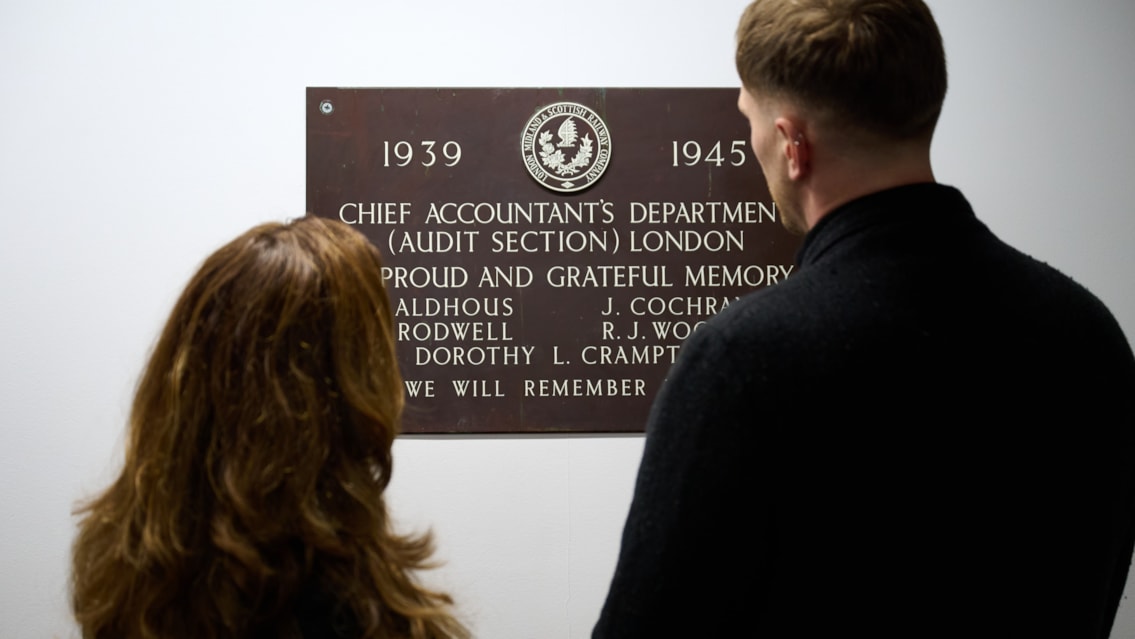
Two historic war memorial plaques honouring railway workers who served during the First and Second World Wars have returned home to London Euston, more than two decades after leaving the station.
The plaques have been proudly installed on Euston’s main concourse, giving passengers and railway colleagues a place to pause and remember the 24 railway colleagues whose names they bear and whose working lives were interrupted by war.
Their return follows a collaborative effort involving Network Rail, Avanti West Coast and the Royal British Legion National Remembrance Gardens, after Tracey Fisher MBE, Archive and Historic Records Director for Intact Insurance, contacted railway staff about bringing the memorials back to Euston.
The Royal British Legion National Remembrance Gardens had cared for the plaques while they were away from the station, but thanks to Tracey and railway teams working together, they have now returned to their railway home and been reunited with other commemorative plaques at Euston.
Among those remembered is Richard Jonathan ‘Dick’ Woodgate, who worked as a railway clerk before serving as a driver with 133 Field Ambulance, Royal Army Service Corps during the Second World War. Dick was captured near Dunkirk and taken to a prisoner-of-war camp in Poland, where it is understood he died from tuberculosis on 22 May 1941, aged just 22.

More than 85 years later, Dick’s story is being remembered by his family, who have shared a photograph of him to help bring to life one of the railway colleagues whose names have now returned to Euston.
Their homecoming is particularly poignant as the railway prepares to mark Armistice Day on Wednesday 11 November when the team at Euston will hold their annual Armistice Day service.
Tom Barry, Station Transformation Programme Manager at London Euston for Network Rail, said: "There is something incredibly special about bringing these plaques back to Euston. They commemorate people from our railway who served their country, so it feels absolutely right that their stories and service should be remembered here.
"This has been a real team effort, and I’m grateful to everyone who has helped us bring the plaques home in time for Armistice Day.
"Behind every name on these plaques is a person, a family and a story. Thousands of people travel through Euston every day, and I hope the memorials encourage people to stop for a moment, learn something about the railway colleagues they commemorate and ensure their stories continue to be remembered."
Tracey Fisher MBE said: "It has been a real privilege to be involved in bringing these memorials to their new home at Euston. Through researching the names recorded on them, I’ve been able to uncover some of the personal stories behind the inscriptions, reminding us that these are not simply names cast in metal, but people who had families, colleagues, hopes and futures.
"It is incredibly moving to see the memorials unveiled and to know that the sacrifice made by these railwaymen and woman will continue to be remembered for generations to come.”
Andy Mellors, Managing Director at Avanti West Coast, said: "We're really proud to have contributed towards returning these plaques to their home at London Euston after speaking with Tracey on our Poppy train's journey to mark Remembrance last year.
"Collaborating with Network Rail on this project highlights the important link that rail has to the Armed Forces and we're pleased that there is now a special space within the station for the memorial, where these railway workers can be honoured by our customers and colleagues alike."
Andy Ansell, Head of Estates at the Royal British Legion National Remembrance Gardens, said: “As the nation’s year-round place to remember, the Royal British Legion National Remembrance Gardens provided a home and cared for these plaques for many years. It is fitting that they have now returned to London Euston, their historic home, where they can inspire a new generation of rail users to learn about the stories of service and sacrifice they commemorate.”
The plaques will now have a permanent home on Euston’s main concourse, bringing an important part of the station’s railway history back into public view and ensuring the contribution of those they commemorate continues to be remembered by future generations.
Notes to Editors
Those commemorated
The two war memorials commemorate 24 railway colleagues connected with Euston and the wider railway, comprising 19 people from the First World War and five from the Second World War. Their railway roles included clerks, apprentices and ticket printers, while their wartime service took them to Europe, the Middle East and beyond.
The following details have been drawn from historical and genealogical research undertaken by Tracey Fisher MBE. While the information has been carefully researched and cross-checked where possible, some historical records remain incomplete.
First World War
- Clement Stanley Clarke – Rifleman, 15th Battalion, Royal Irish Rifles. A railway clerk who later worked in the Coaching Department. Died 21 March 1918, aged 37.
- Leonard Clements – Private, 2nd Battalion, Wiltshire Regiment. A junior clerk who transferred to Euston in 1906. Killed in action on 9 April 1917, aged 30.
- William John Dobson – Rifleman, 21st Battalion, London Regiment. A railway clerk. Killed in action on 23 May 1916, aged 21.
- Frederick William Frost – Private, 3rd Battalion, London Regiment. A railway apprentice who enlisted shortly after joining the railway. Died at Gallipoli on 28 November 1915, aged 20.
- Llewellyn Charlie O. G. Gillett – Private, Royal Buckinghamshire Hussars. Joined the railway in 1897 and later worked in the Secretarial Department. Died 21 November 1917, aged 35.
- Leslie Frederick Lawrence Ginelack – Private, 7th Battalion, London Regiment. A railway apprentice who died of wounds in France on 18 September 1916, aged 20.
- William Arthur Herron – Rifleman, London Regiment, Queen Victoria’s Rifles. A railway ticket printer. Died 9 October 1916, aged 28.
- Henry William Humphreys – Private, 1st Battalion, Royal Fusiliers. Joined the railway in 1906. Died 16 September 1916, aged 25.
- William Edward Liddall – Sapper, Royal Engineers, Inland Water Transport. Joined the railway in 1906 and later worked in the Secretarial Department. Died 30 November 1915, aged 24.
- E. J. Parker, believed to be Ernest John Parker – a railway apprentice clerk who joined the LNWR in 1910 and enlisted in 1914. His identification remains provisional.
- Henry Thomas Parker – Private, 3rd Battalion, London Regiment. An apprentice railway clerk who died at Gallipoli on 28 November 1915, aged 21, on the same day as fellow railwayman Frederick William Frost.
- W. J. Parsons, believed to be William James Parsons – joined the LNWR in 1890 and became an Audit Inspector at Euston. His military identity and precise death details remain subject to further research.
- Henry John Pugh – Private, Machine Gun Corps. Joined the railway in 1907 and was Mentioned in Despatches during his military service. Died 28 September 1918, aged 26.
- Charles Valentine Scott – Private, 1st/7th Battalion, Essex Regiment. Died at Gallipoli on 9 October 1915, aged 25.
- Edward Fred Slade – Rifleman, London Regiment, Queen Victoria’s Rifles. An Audit Department clerk at Euston. Died on active service on 12 August 1915, aged 22.
- Isaac Sproat – Lance Corporal, Royal Engineers. A former railway apprentice who later worked in the Secretarial Division. Died on 16 November 1918, five days after the Armistice, aged 31.
- Reginald George Stevens – Private, 5th Battalion, Dorsetshire Regiment. Joined the railway as an apprentice in 1911. Killed in action on 10 September 1917, aged 21.
- William Robert Williamson – Able Seaman, Royal Naval Division. A railway apprentice who later worked in the Audit Department. Died at Gallipoli on 25 May 1915, aged 19.
- Charles Nottingham Wilson – Private, 23rd Battalion, London Regiment. Joined the railway as a junior clerk in 1901. Died 29 March 1918, aged 31, and is buried in Damascus.
Second World War
- Bernard Joseph Aldhous – Flight Lieutenant, 90 Squadron, Royal Air Force Volunteer Reserve. A railway clerk before the war, he was killed on operations on 9 March 1945, aged 30.
- Deryck Grenville Rodwell – Flight Sergeant and Wireless Operator/Air Gunner, 50 Squadron, RAFVR. A railway clerk before the war. Died during an operation on 8 February 1945, aged 23.
- Jack Haley Cochran – Leading Aircraftman, RAFVR. Recorded as a railway clerk before the war, he served with 416 Repair & Salvage Unit. Died 21 October 1944, aged 36.
- Richard Jonathan “Dick” Woodgate – Driver, 133 Field Ambulance, Royal Army Service Corps. A railway clerk before the war, he was captured near Dunkirk and taken to a prisoner-of-war camp in Poland, where he died from tuberculosis on 22 May 1941, aged 22.
- Dorothy Lilian Crampton – Leading Aircraftwoman, Women’s Auxiliary Air Force. Recorded as a railway clerk before the war, she died on 17 May 1944, aged 26. She is the only woman named on the two memorials.
Research: The histories were researched and compiled by Tracey Fisher MBE. Most entries have been cross-checked against multiple genealogical and historical sources. The identities of E. J. Parker and W. J. Parsons remain provisional and require further checking against LNWR records held at The National Archives.
Contact information
Passengers / community members
Network Rail national helpline
03457 11 41 41
Latest travel advice
Please visit National Rail Enquiries
Journalists
Jonathan Cooke
Senior Communications Manager - On Network Works
Network Rail
0330 8540100 (Option 1)
Jonathan.Cooke@networkrail.co.uk
About Network Rail
We own, operate and develop Britain's railway infrastructure; that's 20,000 miles of track, 30,000 bridges, tunnels and viaducts and the thousands of signals, level crossings and stations. We run 20 of the UK's largest stations while all the others, over 2,500, are run by the country's train operating companies.
Usually, there are almost five million journeys made in the UK and over 600 freight trains run on the network. People depend on Britain's railway for their daily commute, to visit friends and loved ones and to get them home safe every day. Our role is to deliver a safe and reliable railway, so we carefully manage and deliver thousands of projects every year that form part of the multi-billion pound Railway Upgrade Plan, to grow and expand the nation's railway network to respond to the tremendous growth and demand the railway has experienced - a doubling of passenger journeys over the past 20 years.
Follow us on Twitter: @networkrail
Visit our online newsroom: www.networkrailmediacentre.co.uk