Thursday 30 Apr 2026
Public issued stark reminder that there are ‘no second chances’ when using rail level crossings dangerously
- Region & Route:
- Eastern
- | Eastern: East Coast
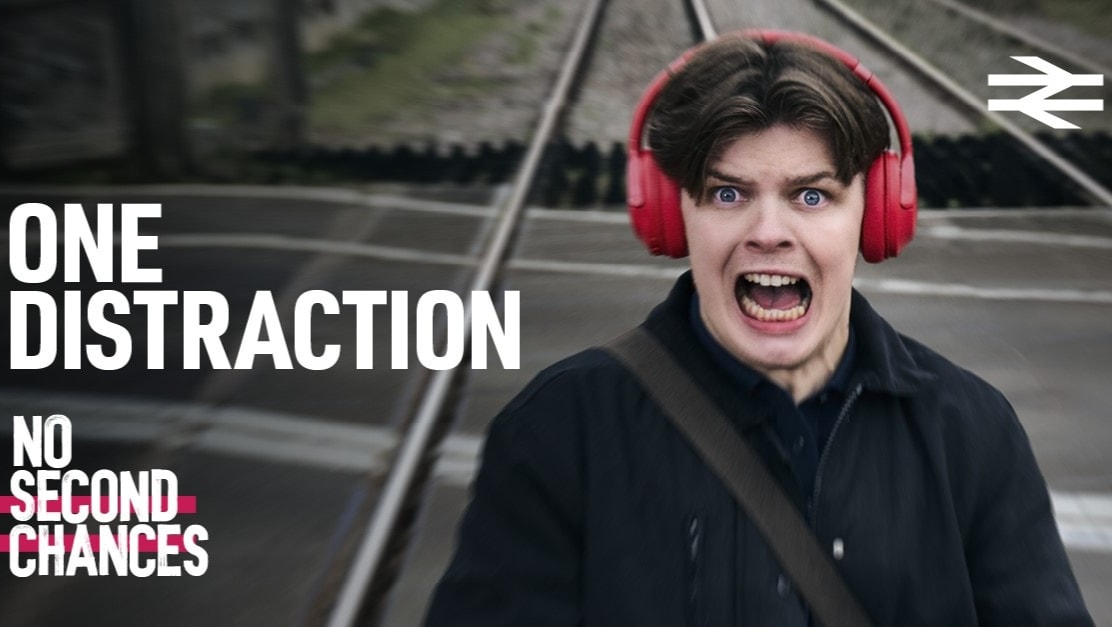
Trains on the East Coast Main Line travel at some of the highest speeds anywhere on Britain’s railway. New campaign No Second Chances is delivering a vital reminder of the cost of distraction at level crossings.
Network Rail, British Transport Police (BTP) and the wider rail community have come together for the first industry-wide level crossing campaign to raise awareness of the severe dangers that can face people if they use level crossings unsafely.
New research revealed a worrying level of overconfidence among the British public when using level crossings. Nationally, more than eight in ten people (84%) claim they understand the dangers around level crossings – but 97% don't realise that it takes approximately one mile for a train travelling at 80mph to come to a complete emergency stop.
And that’s not the fastest speed a train can travel on the network.
Much of the East Coast Main Line between London King’s Cross and Scotland sees trains travelling at 125mph – meaning a stopping distance of over a mile.
There have been 121 near misses (where a train driver applies the emergency brake) on the East Coast Main Line involving trains and pedestrians in the last five years – including 27 incidents in the year to March 2026.
No Second Chances – primarily aimed at 18-34-year-olds through a series of three uncompromising 20-second films – raises awareness of the dangers of not using a level crossing properly and the consequences of being distracted.
David Wortley, route level crossing manager on Network Rail’s East Coast route, said:
“It can be hard to visualise how fast trains move, but describing it as being about 55 metres every second seems to help people understand.
“If you couple that speed with the danger of being distracted by wearing headphones, chatting with others or rushing, the result can be fatal. There really are no second chances in those circumstances.
“It only takes a few seconds to stop, look and listen. Those seconds that could save your life.”
Linda Wain, engineering and safety director at LNER, said:
“It’s incredibly important to be aware of your surroundings at level-crossings. Our trains travel up to 125 miles per hour, meaning they cover 100 metres in less than two seconds, so stopping immediately is impossible. As well, our trains, which are mainly electric, are much quieter than trains in years gone by, meaning people need to be even more alert when crossing the railway.
“That’s why the No Second Chances campaign is so important. By stopping, looking and listening at level crossings, we can protect lives and spare people from the devastation of preventable incidents."

One location on the line where extra safety measures have been added is Copmanthorpe level crossing, south of York. Audible warning alarms were added in late 2025 and have already been seen to make a positive difference.
David continued:
“We monitored the area with CCTV installation after installing the new audible alarms. Footage has already shown several examples where people would likely have crossed without paying full attention had they not heard the warning noise.”
Network Rail is urging the public to stay safe when using level crossings by following the advice:
- Always read the signs and follow instructions, and obey lights, alarms, and barriers.
- Stop, look and listen every time you cross and avoid distraction.
- Check both directions before crossing. If there is a train coming, do not cross. Wait until all tracks are clear. Remember there may be more than one train – another train could be hidden from view by a passing train.
- Never stop on a level crossing. Cross quickly and safely.
- Only cross when all tracks are clear, and where provided, lights and audible warnings are not illuminated or sounding.
Notes to Editors
No Second Chances is running across various channels including social media, digital platforms and outdoor advertising.
The survey was conducted by Censuswide via an online panel of 2,001 UK adults, nationally representative by age, gender and region. Fieldwork was conducted between 8 and 10 April 2026.
Contact information
Passengers / community members
Network Rail national helpline
03457 11 41 41
Latest travel advice
Please visit National Rail Enquiries
Journalists
Gareth Dennison
Media relations manager, Eastern region
Network Rail
07561 874858
gareth.dennison@networkrail.co.uk
About Network Rail
We own, operate and develop Britain's railway infrastructure; that's 20,000 miles of track, 30,000 bridges, tunnels and viaducts and the thousands of signals, level crossings and stations. We run 20 of the UK's largest stations while all the others, over 2,500, are run by the country's train operating companies.
Usually, there are almost five million journeys made in the UK and over 600 freight trains run on the network. People depend on Britain's railway for their daily commute, to visit friends and loved ones and to get them home safe every day. Our role is to deliver a safe and reliable railway, so we carefully manage and deliver thousands of projects every year that form part of the multi-billion pound Railway Upgrade Plan, to grow and expand the nation's railway network to respond to the tremendous growth and demand the railway has experienced - a doubling of passenger journeys over the past 20 years.
Follow us on Twitter: @networkrail
Visit our online newsroom: www.networkrailmediacentre.co.uk