
Tuesday 10 Feb 2026
Planning approval for Network Rail's transformation of Britain's busiest station.
- Region & Route:
- Eastern: Anglia
- On 10 February, the Planning Committee of the City of London passed a resolution to grant planning permission for the transformation of Liverpool Street station.
- The station was last redeveloped in 1991, and customer numbers have tripled over the last 35 years.
The proposals will futureproof Britain's busiest station for decades to come, increasing customer capacity and creating a fully connected, accessible transport hub for customers across the capital and beyond.
Liverpool Street station currently connects 118 million people a year within London, East Anglia and the east of England. With annual passenger numbers forecast to grow by 35% to 158 million by 2041, the approved plans will ensure the station is ready to accommodate more than 200 million people in the decades ahead.
Since opening in 1874, Liverpool Street station and the City of London have developed in parallel, driving each other’s success. The scheme will help drive long-term economic growth across the City of London. Figures show the transformation could boost the City of London economy by up to £4.6 billion per year through increased visitor numbers – a contribution comparable in scale to a 1p change in the basic rate of income tax.*
Transforming the passenger experience
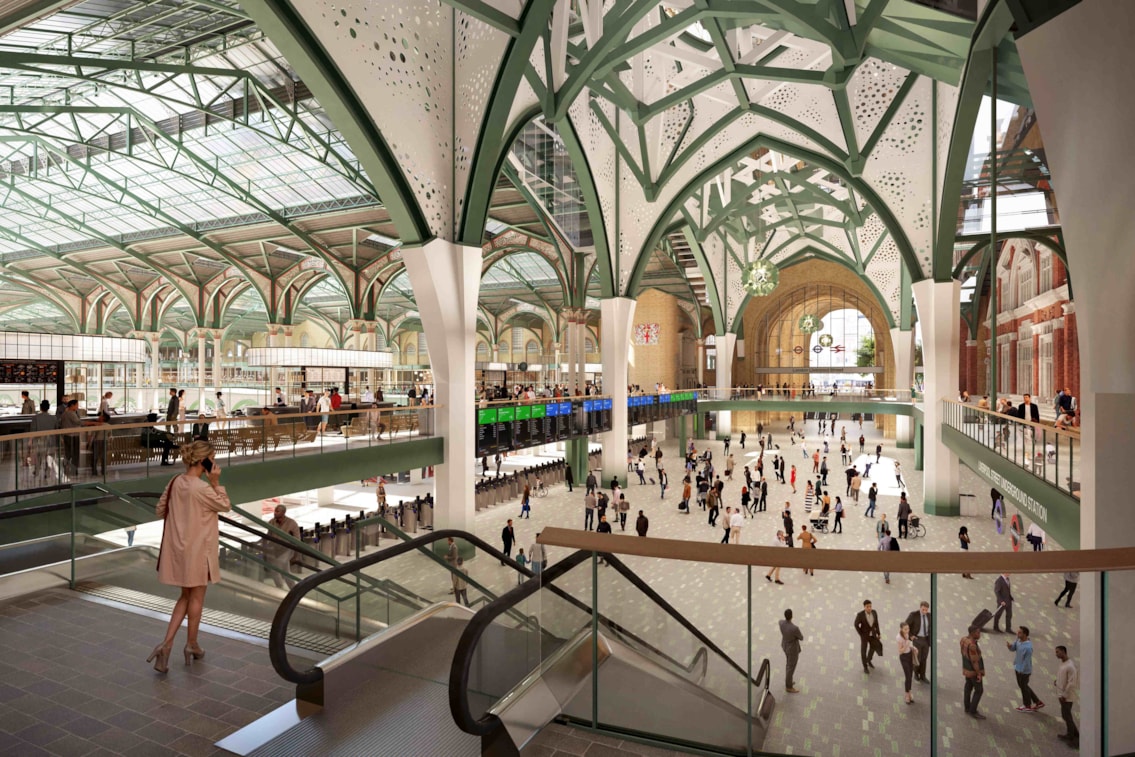
The approved plans will deliver a comprehensive transformation addressing the station's fundamental capacity and accessibility constraints. Key improvements include:
- Overall concourse capacity increased by 76%, with lower concourse space expanded by 23% to dramatically ease passenger flow and reduce congestion
- A fully inclusive station providing step-free access from street level to all platforms – including all London Underground lines for the first time
- Eight new lifts, going from one four-person lift to eight large lifts
- An increase in escalators from four to ten, allowing people to move freely between the street and the concourse
- New landmark accessible entrances and more intuitive wayfinding, from Broadgate, Exchange Square and clear access to buses, bike stores and taxis.
- Toilets on all levels, including family facilities and Changing Places toilets
The station’s next chapter
The scheme has been carefully designed to safeguard Liverpool Street's unique heritage. The Victorian trainshed remains completely untouched.
The transformation will unlock new views over the Victorian architecture, bringing passengers closer to the heritage than ever before.
The infrastructure improvements are contributed to by a new office building with a publicly accessible roof garden. The new office space above the concourse will be the best-connected and the most sustainably located in the capital, contributing towards the City’s growth ambitions
Ellie Burrows, Managing Director for Network Rail's Eastern region, said: "This decision represents a key step towards the transformation of Britain's busiest station and marks the beginning of an exciting new chapter for Liverpool Street.
"Our plans focus on improving the everyday experience for passengers whilst respecting the station's unique heritage. With annual passenger numbers forecast to grow to 158 million, this approval ensures the station will be future proofed for decades to come.”
ENDS
*Direct effects of illustrative tax changes bulletin (January 2025), HM Revenue and Customs.
Network Rail’s design and professional advisory team for the new scheme includes:
- ACME - Architecture
- AECOM – Multi-disciplinary Engineering & Environment
- Certo MS- Project management
- Newmark – Planning & Development
- Gleeds - Cost Management
- Donald Insall Associates - Heritage & Townscape
- GIA – Daylight and Sunlight
- JLL - Valuation
- AVR London - Visualisations
- SLA – Landscape Architecture
- Shared Voice - Communications & Engagement
- Intelligent Data Collection - Pedestrian modelling
- Mima Group – Accessibility & Inclusive design and wayfinding consultants
- Seam – Lighting Design
- RWDI – Wind Engineering
- The Boundary – CGI Views
- Plowman Craven - Surveys
- Sweco – Building Control Advice
- Addleshaw Goddard – Legal
- Publica – Cultural Strategy
Notes to Editors
Media contacts:
Network Rail
- Catrin Sharp, Catrin.Sharp@networkrail.co.uk, 07717 763 552
- Felicity Jump, Felicity.Jump@networkrail.co.uk, 07887 896 411
Shared Voice
- Wyn Evans, wyn@sharedvoice.co.uk, 07909 974 924
- Melissa Flight, melissa@sharedvoice.co.uk, 07811 039 831
Contact information
Passengers / community members
Network Rail national helpline
03457 11 41 41
Latest travel advice
Please visit National Rail Enquiries
Journalists
Catrin Sharp
Head of Communications for Network Rail Property
07717 763 552
catrin.sharp@networkrail.co.uk
About Network Rail
We own, operate and develop Britain's railway infrastructure; that's 20,000 miles of track, 30,000 bridges, tunnels and viaducts and the thousands of signals, level crossings and stations. We run 20 of the UK's largest stations while all the others, over 2,500, are run by the country's train operating companies.
Usually, there are almost five million journeys made in the UK and over 600 freight trains run on the network. People depend on Britain's railway for their daily commute, to visit friends and loved ones and to get them home safe every day. Our role is to deliver a safe and reliable railway, so we carefully manage and deliver thousands of projects every year that form part of the multi-billion pound Railway Upgrade Plan, to grow and expand the nation's railway network to respond to the tremendous growth and demand the railway has experienced - a doubling of passenger journeys over the past 20 years.
Follow us on Twitter: @networkrail
Visit our online newsroom: www.networkrailmediacentre.co.uk