Monday 8 Dec 2025
Network Rail reveals a bridge is struck every five hours, naming Britain’s most-bashed bridges and urging drivers to ‘Wise Up and Size Up’
- Region & Route:
- National
- 1,666 bridges were struck by vehicles in 2024/25 – roughly one every five hours, representing an 8.75% increase on the previous year
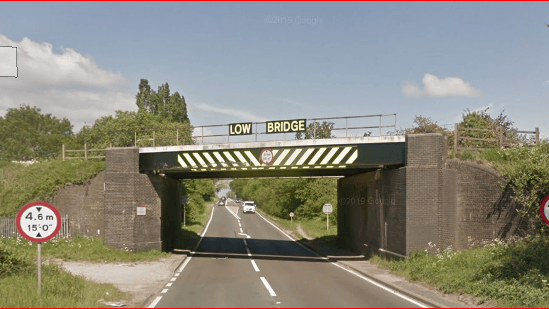
- Watling Street A5 in Hinckley tops the list as Britain’s most bashed bridge, which was hit 22 times in the year
- Network Rail urges lorry drivers to ‘Wise Up, Size Up’ by checking vehicle heights and planning suitable routes to avoid costly and dangerous bridge strikes
New figures released by Network Rail reveal high sided vehicles and other vehicles colliding with bridges caused over 120 days (186,384 minutes) of delays for rail passengers last year. From 1 April 2024 to 31 March 2025 there were 1,666 reported bridge strikes - one every five hours - which cost Britain’s rail industry around £12m in delays and cancellations.
With the busy Christmas delivery period underway, Network Rail is urging haulage operators and their drivers to ‘Wise Up, Size Up’ by checking vehicle heights and planning suitable routes to avoid low bridges.
Network Rail works closely with industry partners to tackle bridge strikes, and its team of bridge strike champions continues to visit haulage companies across Britain to raise awareness and promote safer route planning.
The most-struck bridge in Britain this year is Watling Street A5 in Hinckley, which has been hit 22 times. Close behind are Harlaxton Road in Grantham, struck 18 times, and Stuntney Road in Ely, struck 15 times - costly and avoidable incidents that ripple across the rail network.
Trialling new technology to cut delays
To tackle the problem, Network Rail has partnered with risk-management specialists BES Group to trial a pioneering remote monitoring system at Harlaxton Road bridge in Grantham, one of Britain’s most frequently struck structures, carrying the East Coast Main Line above a junction of six roads.
Despite prominent warning signs, chevrons and protective beams, the bridge was struck 18 times between 2024 and 2025 and three times in a single week last November. One of those incidents alone caused £423,000 worth of damage and 59 hours of delays to rail passengers.
Network Rail hopes the trial will reduce the delays and costs caused by bridge strikes. The remote monitoring system provides real-time alerts using cameras and impact-sensing technology that captures data and video footage instantly after a collision. This allows engineers to assess the bridge within seconds, reducing disruption for passengers and improving safety for staff who would otherwise need to inspect the structure on track.
Martin Frobisher, Network Rail’s group safety and engineering director, said: “Every bridge strike endangers lives, disrupts rail services, and delays tens of thousands of passengers while we inspect and repair the damage to the bridges. Each incident also costs millions of pounds that could instead be spent improving the network.
“With the busiest delivery period of the year underway, we’re reminding all drivers and operators to Wise up, Size Up – ensure they know their vehicle heights before they set off, plan their routes carefully, and watch for low bridge signs. A few moments of vigilance can prevent serious delays and keep everyone moving safely this festive season.”
Hideo Takano, senior structures advisor at National Highways, said: “Bridge strikes can cause hours of disruption and pose serious safety risks. We understand how frustrating these delays are for road users, which is why we work alongside other transport authorities through the Bridge Strike Prevention Group to reduce the number of incidents.
“Two-thirds of strikes on our bridges involve vehicles carrying loads on open trailers. To help prevent them, we urge drivers to take three simple steps: know your vehicle height, plan your route, and make sure your load is secure.”
Notes to Editors
- To find out more about how bridge strikes affect the rail network, click here.
- To find out more about the ‘Wise Up, Size Up’ campaign, click here.
- Network Rail’s 4E’s initiative - education, engineering, enablement and enforcement - aims to ensure haulage companies and their drivers are provided with the knowledge and tools they need to avoid striking bridges.
Most struck railway bridges in Britain 2024/25:
- Watling Street A5, Hinckley - 22 strikes
- Harlaxton Road, Grantham - 18 strikes
- Stuntney Road, Ely - 15 strikes
- Stonea Road, Stonea - 15 strikes
- Lower Downs Road, Wimbledon - 15 strikes
- Station B4105, Berkswell – 14 strikes
- Ickleton Road, Great Chesterford – 11 strikes
- Barrowby Road, Grantham – 11 strikes
- Abbey Farm, Thetford - 11 strikes
- Coddenham Road, Needham Market – 11 strikes
Bridge strikes reported across the railway network in the last five financial years:
Year 2020/21 – 1,650 strikes
Year 2021/22 – 1,864 strikes
Year 2022/23 – 1,588 strikes
Year 2023/24 – 1,532 strikes
Year 2024/25 – 1666 strikes
Contact information
Passengers / community members
Network Rail national helpline
03457 11 41 41
Latest travel advice
Please visit National Rail Enquiries
Journalists
Tala Ghannam
Media & PR Manager - National
Network Rail
020 3356 8700
07548 108907
tala.ghannam2@networkrail.co.uk
About Network Rail
We own, operate and develop Britain's railway infrastructure; that's 20,000 miles of track, 30,000 bridges, tunnels and viaducts and the thousands of signals, level crossings and stations. We run 20 of the UK's largest stations while all the others, over 2,500, are run by the country's train operating companies.
Usually, there are almost five million journeys made in the UK and over 600 freight trains run on the network. People depend on Britain's railway for their daily commute, to visit friends and loved ones and to get them home safe every day. Our role is to deliver a safe and reliable railway, so we carefully manage and deliver thousands of projects every year that form part of the multi-billion pound Railway Upgrade Plan, to grow and expand the nation's railway network to respond to the tremendous growth and demand the railway has experienced - a doubling of passenger journeys over the past 20 years.
Follow us on Twitter: @networkrail
Visit our online newsroom: www.networkrailmediacentre.co.uk