
Tuesday 4 Aug 2026
Network Rail and the National Railway Museum join forces to highlight challenges hot weather poses to train travel
- Region & Route:
- National
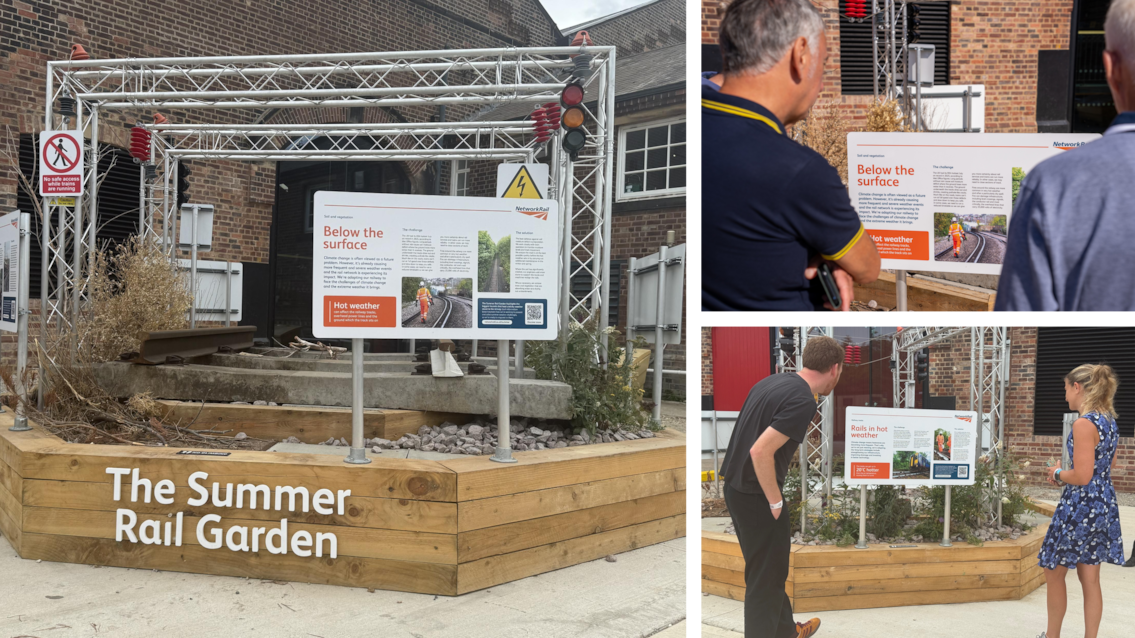
Visitors to the National Railway Museum in York can explore how increasingly hot and dry weather is affecting Britain's railway – thanks to a new garden collaboration with Network Rail.
The museum, which is free to visit, is now home to Network Rail's ‘Summer Rail Garden’. Originally displayed at London Victoria station, the installation helps bring to life the challenges that extreme weather can create for the railway, and some of the measures being taken to help keep passengers and freight moving safely and reliably.
The garden’s arrival comes during a summer that has already seen three heatwaves – including record-breaking temperatures in June – across Britain with hot and dry conditions set to continue into August.
Impacts of hot weather on the rail network include:
- Buckled rails - High temperatures cause steel rails to expand, which can lead to them bending or buckling. This can require trains to run at lower speeds to be safer.
- Soil moisture deficit - Prolonged dry weather causes clay soils and embankments to shrink, increasing the risk of ground movement that can affect track stability.
- Sagging overhead lines - Heat reduces the tension of overhead wires on electrified routes, increasing the risk of sagging or wires making contact with trains, which can disrupt services.
- Overheating equipment - Extreme temperatures can cause signalling and other electrical systems to overheat, increasing the likelihood of faults.
- Lineside wildfires – Drier vegetation during hot weather can create a higher risk of wildfires, near the railway just as elsewhere, with a variety of possible causes. These incidents can cause significant disruption to services.
Lisa Angus, Network Rail's industry weather response director, said: “Due to the effects of climate change, periods of extreme heat and dry weather are becoming more frequent. This summer has already demonstrated some of the challenges that hotter conditions can bring for the railway, with impacts on track, ground conditions, and power and signalling systems.
"The Summer Rail Garden helps explain these impacts in a way that is accessible and engaging, showing visitors how high temperatures can affect rail infrastructure and why adaptation is becoming increasingly important.
“We’re planning years in advance to adapt to changing weather conditions through proactive monitoring and investment in smart technologies – including remote sensors and innovative cooling solutions – to protect critical infrastructure and keep passengers moving safely and reliably during extreme weather.”
Sarah Price, Head of Public Programmes for the National Railway Museum, said: "Throughout its history, railway infrastructure has adapted and evolved to meet new challenges. As climate change brings more frequent periods of extreme weather, understanding how the railway is responding and innovating has become an important part of that story.
"This new garden, kindly donated to us by Network Rail, provides an interesting and accessible way for visitors to learn more about the challenges hot and dry weather can create for the railway, as well as the solutions being developed to help build a more resilient network for the future.”
The garden will be open to the public until late Summer 2026.
Notes to Editors
- The National Railway Museum is free to enter and one of the UK's most popular family attractions, welcoming thousands of visitors each year.
- Information on how the hot weather affects the railway can be found at: Hot weather and the railway - Network Rail
- Information on the National Railway Museum can be found at: National Railway Museum
Contact information
Passengers / community members
Network Rail national helpline
03457 11 41 41
Latest travel advice
Please visit National Rail Enquiries
Journalists
Network Rail press office - National
Network Rail
020 3356 8700
mediarelations@networkrail.co.uk
About Network Rail
We own, operate and develop Britain's railway infrastructure; that's 20,000 miles of track, 30,000 bridges, tunnels and viaducts and the thousands of signals, level crossings and stations. We run 20 of the UK's largest stations while all the others, over 2,500, are run by the country's train operating companies.
Usually, there are almost five million journeys made in the UK and over 600 freight trains run on the network. People depend on Britain's railway for their daily commute, to visit friends and loved ones and to get them home safe every day. Our role is to deliver a safe and reliable railway, so we carefully manage and deliver thousands of projects every year that form part of the multi-billion pound Railway Upgrade Plan, to grow and expand the nation's railway network to respond to the tremendous growth and demand the railway has experienced - a doubling of passenger journeys over the past 20 years.
Follow us on Twitter: @networkrail
Visit our online newsroom: www.networkrailmediacentre.co.uk