Friday 13 Feb 2026
MONDAY: Network Rail to reopen railway between Horsham and Dorking after emergency repairs following landslip
- Region & Route:
- Southern
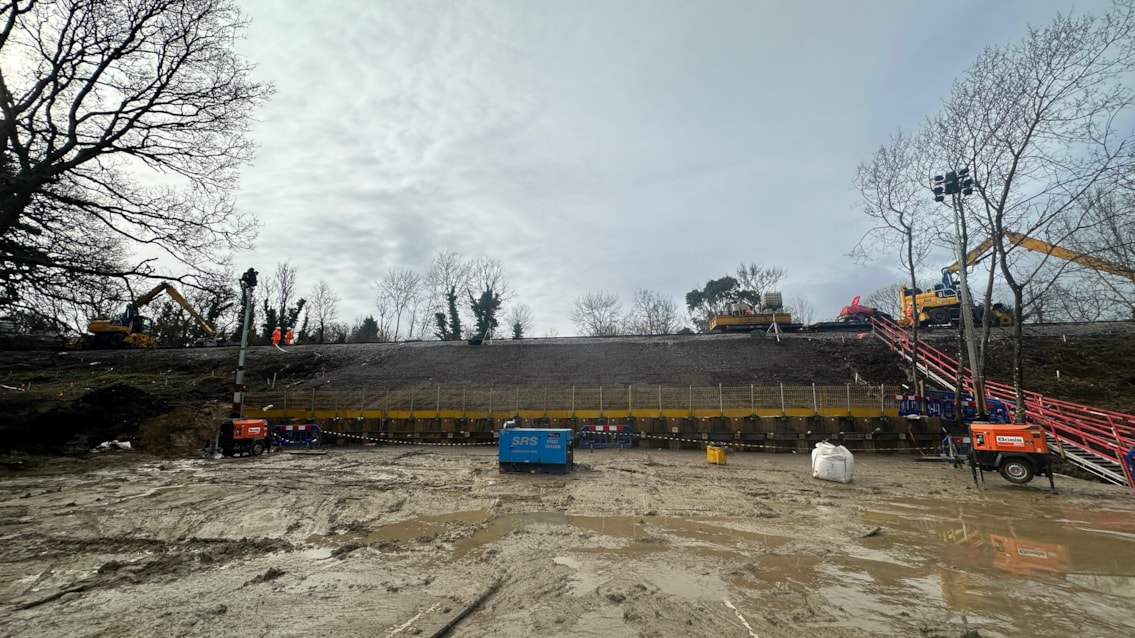
Repairs to the railway at Ockley have been completed following a landslip on an embankment that left one of the tracks hanging in mid-air, meaning that the railway between Horsham and Dorking will reopen to trains as expected, on Monday 16th February.
Network Rail has thanked the local community for their patience following the slip on an embankment to the south of Ockley station, which meant that the two tracks on this stretch of line between Horsham and Dorking had been left impassable since 27th January.
Since teams arrived on site, work has been carried out throughout the day and night to rebuild the railway. Thanks to the full closure of this section of railway, engineers have also ensured that other areas near the landslip site have also benefited from wider proactive works, with 324 soil nails installed on the embankment to strengthen it. At the same time, the ecology of the area around the railway needed to be protected.
The slip happened when the soil gave way along a nine-metre section of embankment, sliding out from underneath the tracks, in what engineers call a ‘rotational failure’. The now strengthened embankment was made of a mixture of soil, saturated after days of heavy rain, on top of a persistently wet winter so far.
Network Rail Sussex route director, Lucy McAuliffe, said: “This was a significant landslip for our teams to respond to, and I can only apologise to passengers who have been impacted by this closure.
“The team worked around the clock to rebuild the railway at Ockley in just a few weeks, which is an incredible achievement, but we know how important this railway is to people and how crucial it was to get regular train services back on track.
“I’d like say a huge thank-you to passengers and to the local community for their patience and support while we made the railway safe again.”
Network Rail project manager, Nad Campbell, said: “Firstly, we needed to stabilise the embankment, stopping it from moving, and then had to rebuild the railway by removing the damaged track and bringing in a piling rig to install 47 steel piles. That meant building a concrete platform strong enough to carry a 50‑tonne machine.
“We also had to remove all of the failed material – 2,800 tonnes of it – and reshaped the slope into what’s called a benched formation, which looks like giant steps. That helped us lock the new stone in and make the structure stronger. By bringing in the new material by train we made a carbon reduction of 76 per cent and removed the need for around 140 deliveries by lorry.
“The team effort involved in rebuilding this section of railway has been fantastic – from Network Rail’s teams to our suppliers at M Group, our drone operators at Mulholland Media who recorded the hive of activity on site, and the excellent working relationship our ecologists have had with Natural England in ensuring dormice licences were issued in record time.”
Throughout the work, Southern was able to maintain a half-hourly train service between Dorking and London Victoria, but it has been running buses only between Horsham and Dorking, stopping at the stations of Warnham, Ockley and Holmwood in between. Passengers have also been able to use alternative Southern and Thameslink services between Horsham and London Bridge or London Victoria, all taking the alternative route towards the capital via Gatwick Airport.
Jenny Saunders, Customer Service Director for GTR that runs Southern Railway, said: "Through careful work, we've managed to keep the vast majority of our passengers on the move by train, but for local trips it has been necessary to take one of our buses, which has taken longer. So, it really is very good news that the landslip is now repaired and we can restore our full service. I am grateful for our passengers' understanding and patience and thank Network Rail for reopening the tracks on time."
Notes to Editors
Broadcasters: B-roll is available on request. Please contact paul.prentice@networkrail.co.uk.
Network Rail is working hard to combat the effects of climate change on the railway. More information can be found here:
https://www.networkrail.co.uk/sustainability/climate-change/climate-change-adaptation/
Contact information
Passengers / community members
Network Rail national helpline
03457 11 41 41
Latest travel advice
Please visit National Rail Enquiries
Journalists
Paul Prentice
Communications Manager
07354 529345
paul.prentice@networkrail.co.uk
About Network Rail
We own, operate and develop Britain's railway infrastructure; that's 20,000 miles of track, 30,000 bridges, tunnels and viaducts and the thousands of signals, level crossings and stations. We run 20 of the UK's largest stations while all the others, over 2,500, are run by the country's train operating companies.
Usually, there are almost five million journeys made in the UK and over 600 freight trains run on the network. People depend on Britain's railway for their daily commute, to visit friends and loved ones and to get them home safe every day. Our role is to deliver a safe and reliable railway, so we carefully manage and deliver thousands of projects every year that form part of the multi-billion pound Railway Upgrade Plan, to grow and expand the nation's railway network to respond to the tremendous growth and demand the railway has experienced - a doubling of passenger journeys over the past 20 years.
Follow us on Twitter: @networkrail
Visit our online newsroom: www.networkrailmediacentre.co.uk