Friday 18 Sep 2026
Hidden tunnel tours return for Birmingham Heritage Week
- Region & Route:
- North West & Central
- | North West & Central: Central
Tours of tunnels running beneath Birmingham New Street and the city centre have returned as part of Birmingham Heritage Week.
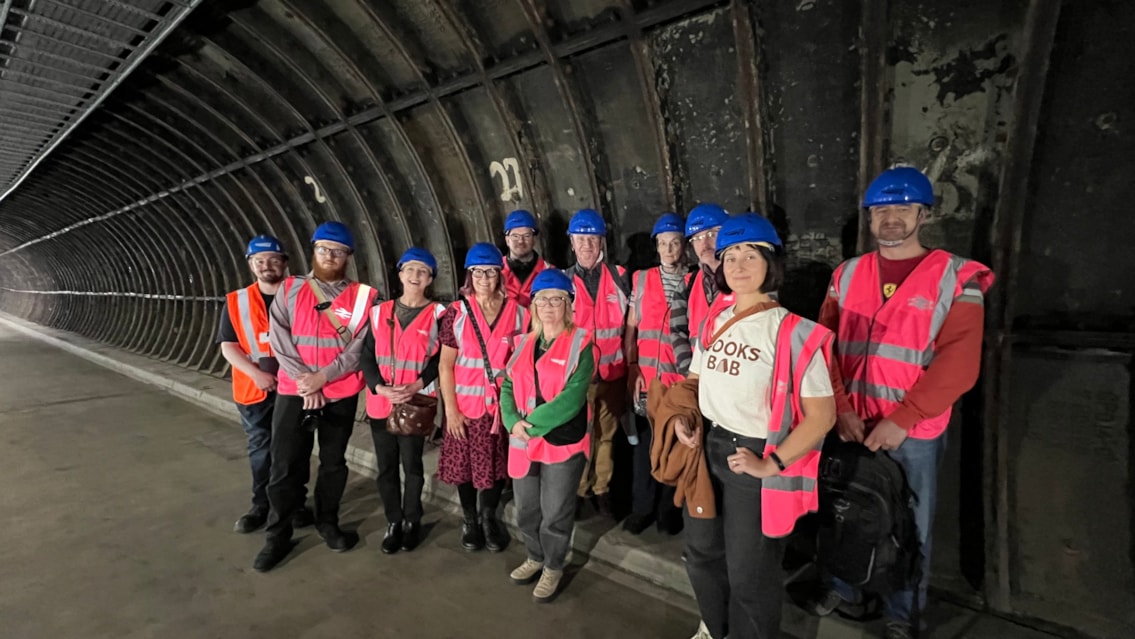
Network Rail, the Mailbox and Birmingham Museums gave 30 lucky people a rare chance to go behind (or under!) the scenes and explore the former mail and service tunnels this week.
During three separate tours, the ballot winners walked through the 400-metre-long tunnel linking Mailbox with the station and discovered how it once carried Birmingham’s post directly to mail trains which then travelled across Britain.
They also saw a number of service tunnels, which connect platforms and facilities, which are still in use today underneath Birmingham New Street.
The ballot-only event attracted strong demand once again, with over 3,000 people entering for the chance to secure one of the limited tour places.
Adam Turner, who was the lead guide for the tours for Network Rail, said: “We were delighted to bring these fascinating tours back for Birmingham Heritage Week after such an enthusiastic response last year. The tunnels are a remarkable hidden part of the city’s railway and postal story, and it’s a privilege to show visitors how Birmingham’s post once travelled from the Mailbox to trains at Birmingham New Street, and the tunnels that remain enjoying a quiet retirement. We hope everyone who was lucky enough to take part enjoyed this rare look behind the scenes.”
James Walley, a guest on the tunnel tour, said: “Thank you for the tour! The tour was really informative, with some great history of the station and its relationship with the post office. As a civil engineer it really was a special experience to see some hidden infrastructure in our city.”
Guest, Heide Goody, said: “I felt as if I'd won the jackpot when I was selected in the ballot for the Mail Tunnel Tour. I was so excited for the tour before we started, and even then, it still surpassed my expectations! Hats off to everyone involved!”
A spokesperson for Mailbox said: “We are delighted to welcome visitors back into the historic tunnels once again as part of Birmingham Heritage Week 2026. Mailbox is a destination that bridges Birmingham’s vibrant past with its future, and we are proud to partner with Network Rail to offer the unique opportunity to explore these long-hidden underground spaces. This collaboration allows us to share an important and fascinating piece of Birmingham's railway history while celebrating the heritage and stories that make our city so special.”
Irene De Boo, co-ordinator of Birmingham Heritage Week, said: “The mail tunnel between New Street station and Mailbox is a hidden space not normally accessible to the public. Very few people have seen it. I am pleased that Birmingham Heritage Week offers people a chance, via a ballot, to win a ticket to walk the length of the tunnel from New Street to the Mailbox and explore a very unusual part of Birmingham's Heritage.”
When it opened in 1970, the sorting office was the largest building in Birmingham, boasting a vast floor area of 81,000m². It also housed the largest mechanised letters and parcels sorting machinery in the country.
Special electric vehicles known as ‘Brutes’ transported mail sacks through underground tunnels, linking directly to mail trains at Birmingham New Street station.
Birmingham Heritage Week runs from 11 to 20 September 2026, with events and activities celebrating the city’s heritage. You can find out more at www.birminghamheritageweek.co.uk
Notes to Editors
Between 1889-91 Birmingham General Post Office was built facing Victoria Square by Sir Henry Tanner (Grade II) - the sorting office was built behind (the sorting office part of the building was demolished and redeveloped in the 1990s as offices).
There was an existing tunnel under platform 1 for the safe movement of oil lamps and known to this day as the Lamp Tunnel, linking with the western subway (that serves each platform originally for baggage and parcels etc).
In 1894 the London North Western Railway Company and HM Postmaster General entered into an agreement to allow the PMG to construct a link from the sorting office to the Lamp Tunnel.
Birmingham was the largest provincial sorting office but prior to WW2 it was struggling to sort the huge volumes of post and parcels but WW2 delayed a modern replacement until the late sixties.
The tunnel connection to the railway via the Lamp Tunnel helped the Victoria Square sorting office limp on until in the sixties a new sorting office had to be built (this is the site of the Mailbox complex today).
In 1966 the Postmaster General obtained an Act of Parliament to construct a new tunnel to its new Birmingham sorting office (under the Post Office (Subway) Act 1966).
The new sorting office would be Europe’s largest built on former railway land (part of the former Birmingham Central Goods station site). The new sorting office cost approx. £8m (sixties prices) and was constructed 1966-1968.
The tunnel is approx. 570 ft long, 14ft in diameter and 20ft depth and cost £200k to build (sixties prices). The contractor was Balfour Beatty & Co and the consulting engineer was Sir William Halcrow and Partners.
The tunnel break through at New Street station was on 23 May 1967.
Contact information
Passengers / community members
Network Rail national helpline
03457 11 41 41
Latest travel advice
Please visit National Rail Enquiries
Journalists
North West and Central Media Relations
Press Office
Network Rail
NWCmediarelations@networkrail.co.uk
About Network Rail
We own, operate and develop Britain's railway infrastructure; that's 20,000 miles of track, 30,000 bridges, tunnels and viaducts and the thousands of signals, level crossings and stations. We run 20 of the UK's largest stations while all the others, over 2,500, are run by the country's train operating companies.
Usually, there are almost five million journeys made in the UK and over 600 freight trains run on the network. People depend on Britain's railway for their daily commute, to visit friends and loved ones and to get them home safe every day. Our role is to deliver a safe and reliable railway, so we carefully manage and deliver thousands of projects every year that form part of the multi-billion pound Railway Upgrade Plan, to grow and expand the nation's railway network to respond to the tremendous growth and demand the railway has experienced - a doubling of passenger journeys over the past 20 years.
Follow us on Twitter: @networkrail
Visit our online newsroom: www.networkrailmediacentre.co.uk