Tuesday 1 Sep 2026
East Coast digital milestone signals a new era
- Region & Route:
- Eastern
- | Eastern: East Coast
- First use of digital in-cab signalling for services on the East Coast Main Line
- Great Northern Class 717s start the digital journey by using in-cab signalling between Welwyn and Hitchin
- Step towards the first full use of digital signalling on an intercity main line in this country
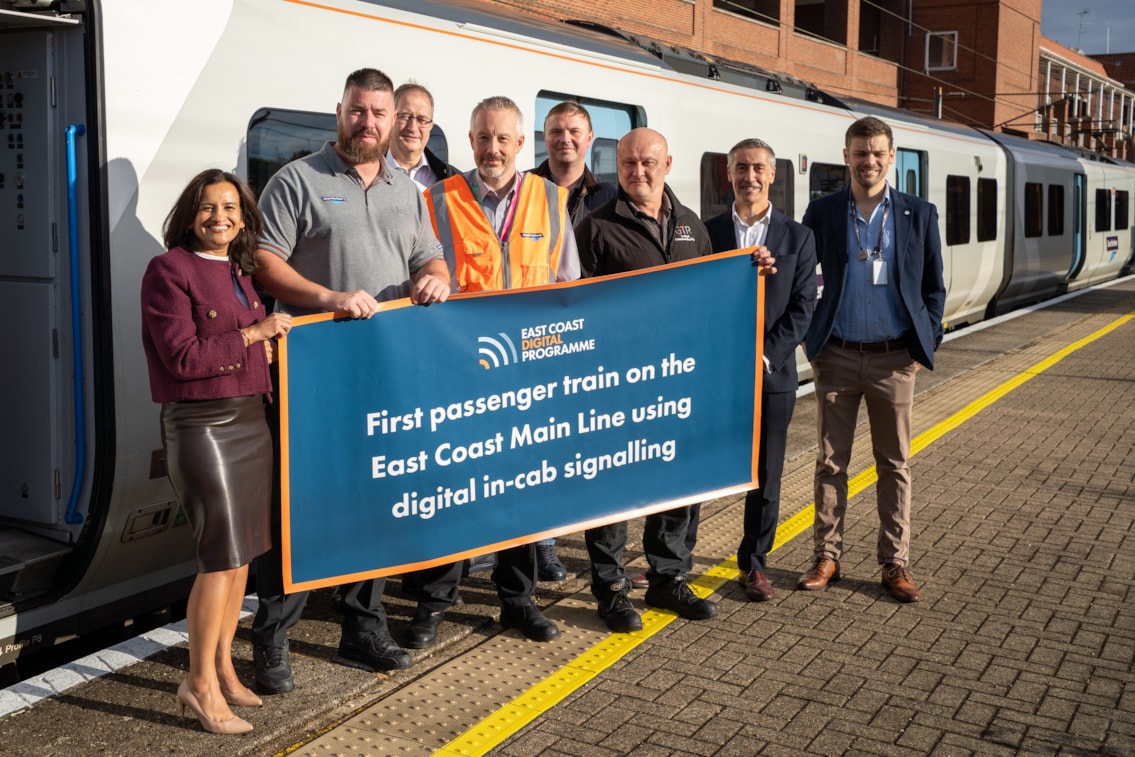
Digital in-cab signalling has been used by passenger trains on the East Coast Main Line for the first time.
The 08.05 Great Northern service to Moorgate on Monday 31 August was the first passenger train to use the new system on the main line as it was signalled out of Welwyn Garden City station.
It’s the latest milestone for the £1.4 billion Government-funded East Coast Digital Programme (ECDP), which will see traditional lineside signals replaced with a system that tells train drivers on an in-cab computer screen how far and how fast they can travel.
Over the long term, digital signalling will deliver more efficient, more reliable and greener services. Once all trains operate with digital signalling, these benefits come through less reliance on trackside equipment and better ability to manage the response to disruption and delays. The system also makes the railway even safer as it supervises the train’s speed and can bring it to a stop if needed.
This first stage in the use of the European Train Control System (ETCS) on the East Coast Main Line now sees Great Northern’s modern Class 717 fleet transition in and out of the system when entering and leaving the Welwyn to Hitchin area. The 15-mile section has been successfully commissioned as an ‘overlay’, meaning trains can operate through it using either conventional or digital in-cab signalling, allowing drivers to be trained in the technology. More fleets and passenger services will begin using the in-cab system from 2027.
Rail minister Lord Hendy said:
“This is a landmark moment for this vital main line. Backed by £1.4 billion of Government investment, it’s a clear demonstration of our commitment to building a more reliable, more efficient railway that gets people where they need to be.
“This is exactly the kind of transformation that will underpin Great British Railways as we deliver a simpler railway for passengers, with track and train working together as one to improve our network for the people who use it.“
Ellie Burrows, Network Rail regional managing director, said:
“This is the start of a generational change in how the East Coast Main Line, which carries more than 20 million passengers each year, is operated.
“Digital signalling will give passengers and freight customers a more capable and higher performing railway, not just on the East Coast but ultimately across the country.
“I’m grateful to passengers for their patience while the testing work was carried out, and I want to thank all industry colleagues involved in getting through the rigorous process of testing, assurance and approvals that has led to this milestone.”
Adrian Gogay, infrastructure director at GTR, which operates Great Northern, said:
“This is a massively important moment for the railway, introducing digitally controlled passenger services to the busy East Coast Main Line for the first time, promising passengers in the future, more reliable, more efficient, greener and even safer services.
“The lessons we learned together as an industry switching on in-cab signalling in central London between Moorgate and Finsbury Park have proved immensely important for us all. I’m very proud of our collaboration and the dedication shown by our drivers, operational colleagues and industry partners, whose expertise and commitment have made this achievement possible.
“This stretch of digitally controlled track between Welwyn and Hitchin provides the opportunity for all operators to train drivers ready for the system to be extended still further.”
Rob Morris, joint chief executive officer and managing director for rail infrastructure and software at Siemens Mobility UK&I, said:
“This milestone proves that the industry is ready for digital signalling on one of the busiest main lines in the country. As the train control partner and systems integrator, we’ve successfully delivered the European Train Control System, testing and validating it remotely at our digital-twin integration lab in Chippenham, Wiltshire to minimise disruption to services, while maintaining the highest standards of safety.
“A decade of delivering digital signalling on projects such as Thameslink and more recently the Northern City Line has shaped how we’ve approached this programme, and that experience now carries forward as we work with our industry partners on future schemes to transform rail travel and transport for millions of passengers.”
For more information about the East Coast Digital Programme and digital in-cab signalling, visit www.eastcoastdigitalprogramme.co.uk.
Notes to Editors
The service groups now using ETCS on the East Coast Main Line (ECML) are the Great Northern services that operate between Moorgate and Welwyn Garden City, and Moorgate and Stevenage via Hertford North. These services now begin and end their journeys in ETCS Level 2 (i.e. train’s movements being supervised by ETCS) as the section between Moorgate and Finsbury Park operates as a ‘no signals’ ETCS railway.
The regular service pattern will see these services, operated by Great Northern Class 717s, transition in and out of ETCS Level 2 south of Welwyn Garden City, and south of Stevenage from the Hertford Loop. There are also a small number of services at certain times of the day (early morning/late evening) that extend to/from Letchworth, so go through a larger amount of ETCS area.
Contact information
Passengers / community members
Network Rail national helpline
03457 11 41 41
Latest travel advice
Please visit National Rail Enquiries
Journalists
Gavin Bostock
Communications manager
Network Rail
gavin.bostock@networkrail.co.uk
About Network Rail
We own, operate and develop Britain's railway infrastructure; that's 20,000 miles of track, 30,000 bridges, tunnels and viaducts and the thousands of signals, level crossings and stations. We run 20 of the UK's largest stations while all the others, over 2,500, are run by the country's train operating companies.
Usually, there are almost five million journeys made in the UK and over 600 freight trains run on the network. People depend on Britain's railway for their daily commute, to visit friends and loved ones and to get them home safe every day. Our role is to deliver a safe and reliable railway, so we carefully manage and deliver thousands of projects every year that form part of the multi-billion pound Railway Upgrade Plan, to grow and expand the nation's railway network to respond to the tremendous growth and demand the railway has experienced - a doubling of passenger journeys over the past 20 years.
Follow us on Twitter: @networkrail
Visit our online newsroom: www.networkrailmediacentre.co.uk